Coimbra in Autumn, Portugal: Weather, Crowds and What to Do
Autumn is the season the climate data quietly favours: September in Coimbra, Portugal is warmer than June, the heavy rain holds off until October, and the summer crowds are gone.
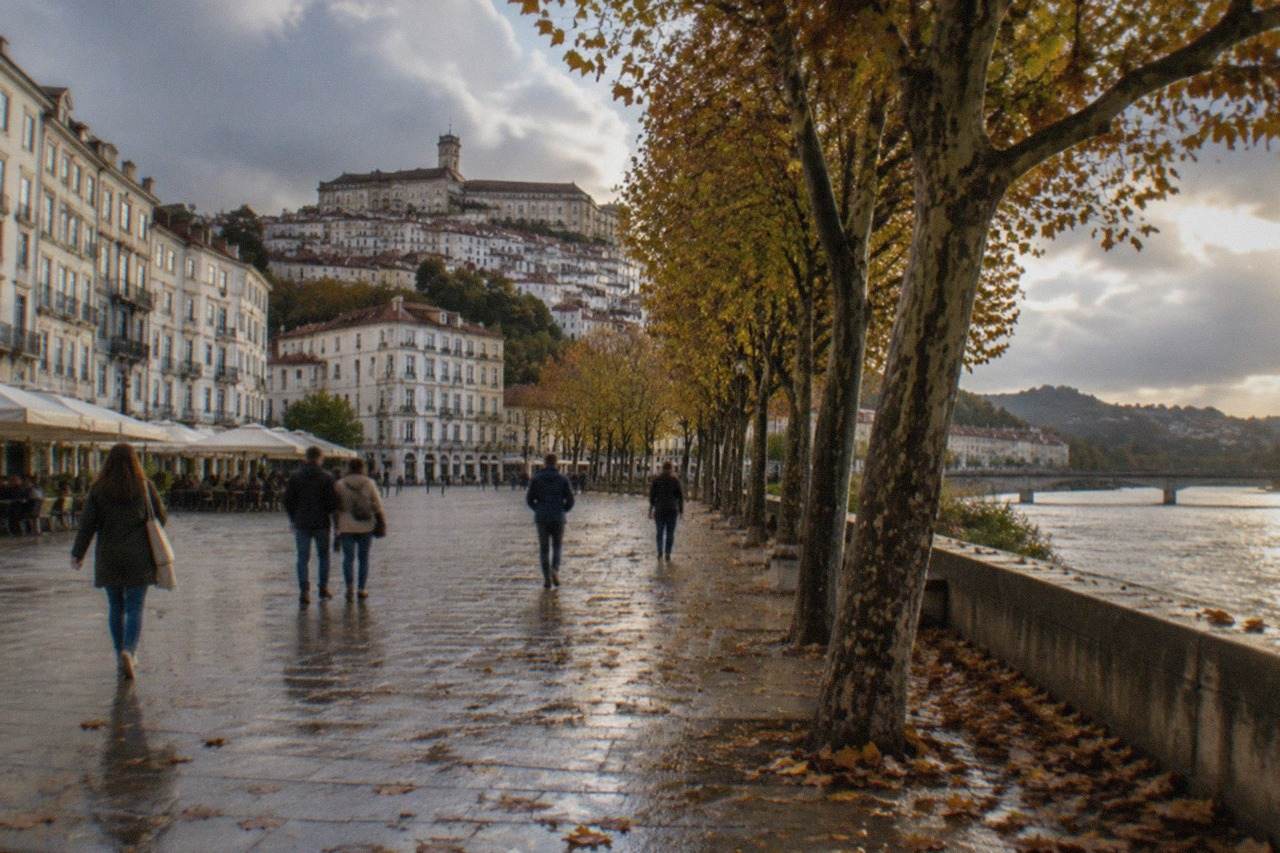
Short answer
Coimbra in autumn runs on two clocks. The weather stays summer-like through September, with a mean maximum of 27.4 C, and only turns properly wet in October, when rainfall jumps from 49.9 mm to 114.5 mm. Meanwhile the visitor sites switch to winter schedules from 1 October, and two major museums remain closed for conservation work.
Coimbra, Portugal, the university city on the River Mondego, is at its most agreeable in autumn, and the official numbers back that up rather than merely suggesting it. IPMA's 1991 to 2020 normals for the Coimbra / Bencanta station, the city's own weather station 3 km from the centre, show a September that is warmer than June and an October that is when the rain truly begins. The student calendar, which shapes this city more than any other force, restarts in full in October, and the visitor circuit switches to winter hours on 1 October. This guide lays out what those dates and figures mean in practice: what the weather does month by month, which sites change their schedules, what is currently closed, and what is worth doing between September and December.
What Is Autumn Weather Like in Coimbra, Portugal?
Autumn in Coimbra opens warm and closes wet. September's mean maximum is 27.4 C, which is higher than June's 26.3 C, and the month still only averages 49.9 mm of rain. October drops to a 23.2 C mean maximum but the rain more than doubles to 114.5 mm, and November is the wettest month of the entire year at 121.5 mm. December cools to a 15.6 C mean maximum with 111.3 mm of rain.
Those figures come from IPMA's climate normals for the Coimbra / Bencanta station, series 1991 to 2020, which is the city's own station rather than a coastal proxy. That distinction matters here: the district of Coimbra reaches the Atlantic, but the city does not touch the sea, so coastal weather is a different place. The table below is the autumn block of that series in full.
| Month | Mean max C | Mean C | Mean min C | Rain mm | Days with 1 mm+ rain | Days max 30 C+ |
|---|---|---|---|---|---|---|
| September | 27.4 | 20.7 | 14.1 | 49.9 | 5.2 | 7.8 |
| October | 23.2 | 17.6 | 11.9 | 114.5 | 10.3 | 2.0 |
| November | 18.0 | 13.2 | 8.3 | 121.5 | 11.5 | 0.0 |
| December | 15.6 | 10.9 | 6.2 | 111.3 | 11.1 | 0.0 |
Two readings of that table are worth spelling out because most guides get them backwards. September is not a cool, damp prelude to autumn. It is a warm month, hotter on average than June, with an average of 7.8 days above 30 C. And it is wetter than June too, 49.9 mm against 26.0 mm, so the honest framing is not that September is dry. The honest framing is that the serious rain holds off until October, when the monthly total jumps from 49.9 mm to 114.5 mm, and that by then the summer visitors have gone home.

The record extremes at the same station put the season in perspective: the highest temperature ever recorded there is 41.2 C on 7 August 2016, and the lowest is -4.3 C on 20 January 2017. Neither extreme belongs to autumn. A September afternoon can still feel like high summer, and a November night can feel properly cold, but the season itself sits between the two comfortably. For a month-by-month comparison across the whole year, the Coimbra weather guide carries the full IPMA table, and the broader question of timing is covered in the best time to visit Coimbra.
When Does the Autumn Rain Actually Arrive in Coimbra?
The real change arrives in October, not September. September averages 49.9 mm of rain over 5.2 days, while October averages 114.5 mm over 10.3 days, roughly double the rainfall on double the rainy days. November then edges past October as the wettest month of the year at 121.5 mm over 11.5 days, and December holds at 111.3 mm.
The practical version of that is simple. Early autumn, meaning September and the first stretch of October, is a reliable window for everything outdoors: the university hill climb, the riverside, the botanical garden, day trips into the hills. From mid-October onwards, plan around rain the way you would in any northwestern Iberian city, with indoor options ready. Coimbra has enough of them that a wet day is not a lost day, and the rainy day guide on this site is built for exactly that.
One more pattern from the normals table is worth carrying: Coimbra's rain is autumn and winter rain. July, at 8.9 mm, is effectively dry, and June sits at 26.0 mm. The wet half of the year switches on in October and does not switch off until spring. If a September visit looks appealing on the numbers, it is because the switch has not yet been thrown, not because there is no switch.

What Are the Best Things to Do in Coimbra in Autumn?
The best autumn activities are the ones the summer heat makes hard: walking the steep old town lanes, touring the university hill and the Biblioteca Joanina, and taking the river boat on the Mondego, all of which are at their most pleasant in September and early October. From late October, the indoor circuit takes over: the Joanina Library, the Science Museum spaces, fado houses and the city's cafes and museums.
The walking argument is arithmetic. The climb from the Baixa up to the Paço das Escolas is steep, cobbled and unshaded in stretches, and doing it at 29 C in August is a different experience from doing it at 23 C in October. A guided walk that covers the top attractions in about two and a half hours makes sense of the hill, because the layout of the old town, Alta above and Baixa below, is easier to read with someone explaining it.
The university deserves the biggest single block of an autumn day, and autumn is when it comes back to life. The University's own published figure is about 31,000 students, and the academic year is running by October, so the city has its population back: black capes in the streets, fado drifting out of the Repúblicas in the evening, and the queues at the Joanina shorter than in July and August but still real. The library admits 50 people every 20 minutes and the time printed on your ticket is the library slot specifically, so a slot bought for the wrong part of the day cannot be swapped on the doorstep. The Joanina Library tickets guide covers the mechanics in detail.

The river is the third piece. The Mondego is calm in autumn, and a 50-minute traditional boat trip gives a view of the city, the university hill and the green of the Choupal forest on the far bank, without a climb. It is the one sight in Coimbra that involves sitting down, which has its own value after a morning on the hillsides.
Fado belongs to the autumn evening. Coimbra's fado is a student tradition, sung by men in capes, and it is tied to the academic calendar rather than the tourist one. The full story of that tradition, and where the fado houses are, is in the Coimbra fado guide, and the practical question of where to hear it is answered in where to hear fado in Coimbra. Beyond the city, the schist villages of the Lousã mountain and the Roman ruins of Conímbriga are both autumn-perfect day trips, cooler under foot than in August, and the day trips guide lays out the options.
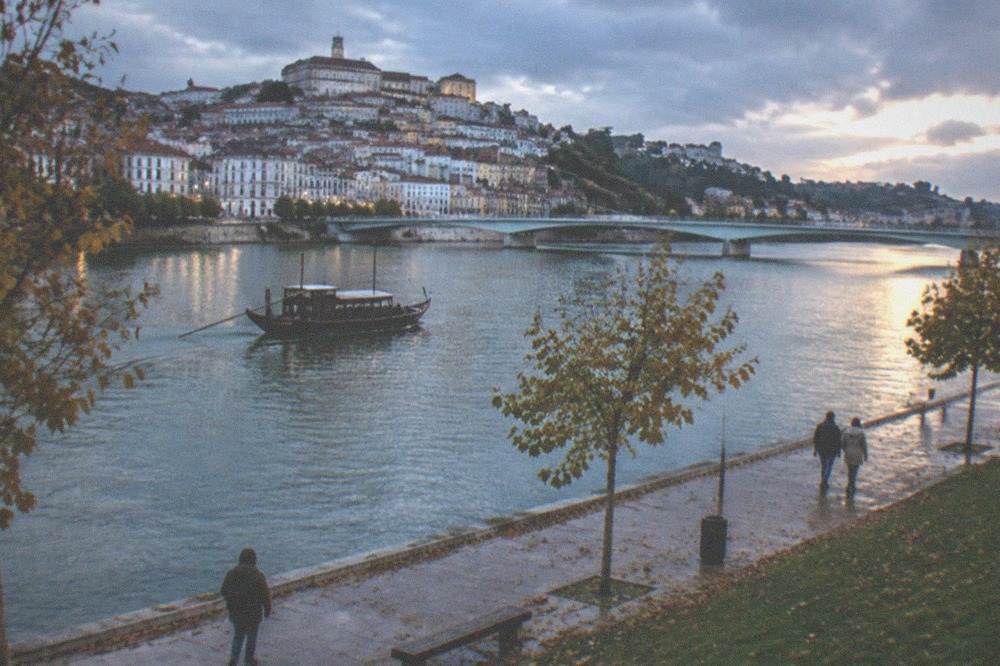
Which Coimbra Sites Change Their Hours in Autumn?
The University of Coimbra switches to its winter schedule on 1 October, opening 09:00 to 17:30 instead of the summer's 09:00 to 20:00, and Portugal dos Pequenitos cuts its hours from 10:00 to 19:00 to 10:00 to 17:00 from 16 October. Sé Velha runs 09:30 to 17:30 in winter, Mosteiro de Santa Cruz runs 09:30 to 16:30 year-round, and Conímbriga keeps daily 10:00 to 18:00 hours with the ticket office closing at 17:15.
Those are the schedule changes that actually affect an autumn plan, drawn from each venue's own published hours. The University's cut is the significant one: in September you can visit the Paço das Escolas until 20:00, and from 1 October the last entries move more than two hours earlier, so the late-afternoon slot that worked in summer stops existing. Sé Velha's winter hours, published by the Unidade Pastoral Aeminium, run 09:30 to 17:30 with Sundays at 11:00 to 17:30.
| Site | Autumn hours | Source of the change |
|---|---|---|
| University of Coimbra, Paço das Escolas | 09:00 to 17:30 from 1 October | Winter schedule, visit.uc.pt |
| Sé Velha de Coimbra | 09:30 to 17:30, Sundays 11:00 to 17:30 | Winter hours, parish site |
| Mosteiro de Santa Cruz | 09:30 to 16:30, Sundays on a separate schedule | Year-round hours |
| Conímbriga, museum and ruins | Daily 10:00 to 18:00, ticket office to 17:15 | Year-round hours |
| Portugal dos Pequenitos | 10:00 to 17:00 from 16 October | Seasonal hours, venue site |
Conímbriga deserves a special note for the autumn visitor, and not only for the weather. The site, a Roman town in the parish of Condeixa-a-Velha in the municipality of Condeixa-a-Nova, roughly 16 km south of Coimbra, opens seven days a week. That makes it the reliable Monday option in a region where several national monuments close on Mondays. The full site guide is at Conímbriga Roman ruins.
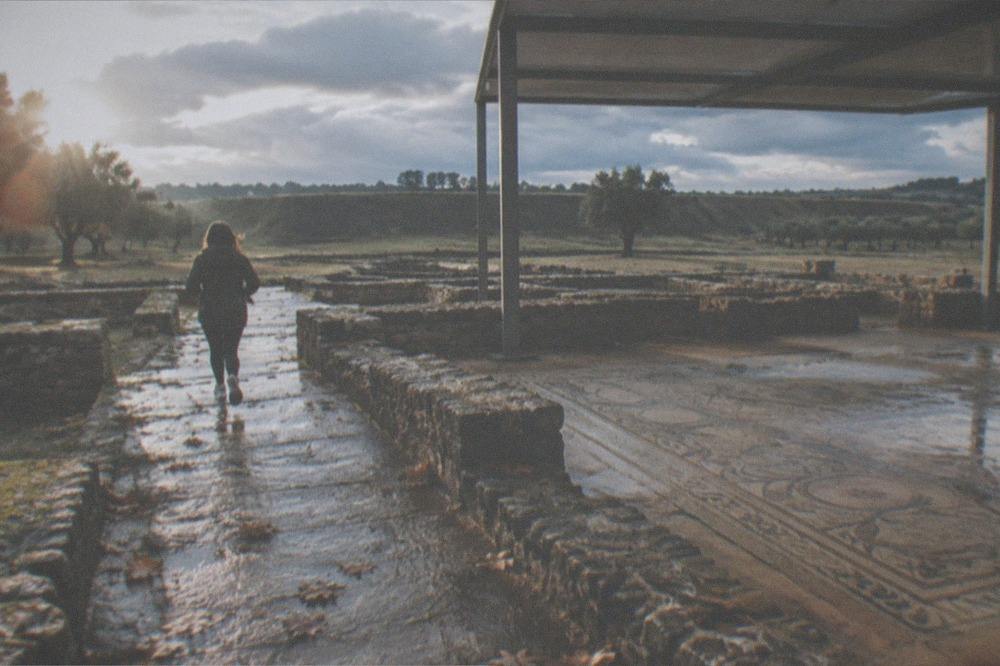
What Is Closed in Coimbra in Autumn 2026?
Three things are closed and should not appear in an autumn plan: the Museu Nacional de Machado de Castro, closed for conservation work with no published reopening price; Mosteiro de Santa Clara-a-Velha, closed for requalification works since 20 October 2025; and the Torre da Universidade, the clock tower, which the University's own page states is closed. The Joanina Library remains open, but only inside the 16.50 EUR combined ticket, at 50 people per 20-minute slot.
The Machado de Castro closure is the one that catches visitors out, because the museum's own page prints a normal-looking opening-hours table below the closure notice. The museum, built above a Roman cryptoporticus of the mid-1st century, is a headline attraction in every guidebook, and the building is not currently receiving the public. The tower closure is similar: the University's information page states plainly that the facility is closed, so no ticket, at any price, buys the 184-step climb.
| Site | Status in autumn 2026 | What to do instead |
|---|---|---|
| Museu Nacional de Machado de Castro | Closed for conservation work | Science Museum spaces on the UC ticket |
| Mosteiro de Santa Clara-a-Velha | Closed for requalification works | Santa Cruz and Sé Velha, both open |
| Torre da Universidade | Closed, per the UC's own page | The terrace views from the Paço das Escolas |
| Biblioteca Joanina | Open, timed slots, 16.50 EUR combined ticket only | Book the slot before arriving |
The Joanina, by contrast, is fully running, and it is the one place in the city where scarcity is real and official. The University's own program page sets the ceiling at 50 people every 20 minutes, refuses entry outside the printed slot, and closes online sales 20 minutes before the visit time. A combined ticket at 16.50 EUR covers the library, the Royal Palace, the Capela de São Miguel, the Chemistry Laboratory, the Academic Museum, the Cabinet of Curiosities and the Mineral Gallery, and is valid two days except for the fixed library slot. Inside, the library's resident bat colony, which the University credits with eating the insects that would otherwise damage the books, is part of the same official story.

A guided option is worth weighing here, because the timed-slot rule punishes improvisation. A university-and-city tour with a guide handles the ticketing and the timing in one booking.
What Should You Pack for Coimbra in Autumn?
Pack for two seasons in one bag: September calls for summer clothing, sun protection and a light layer for evenings around 14 C, while late October through November needs a proper rain jacket, waterproof footwear for the cobbles, and warm layers for nights that average 8.3 C in November. An umbrella is useful from October, and the steep lanes make gripped shoes worth bringing all season.
The normals table does the packing list for you, because the drop across the season is steep. A September mean minimum of 14.1 C means restaurant terraces stay comfortable at night. A November mean minimum of 8.3 C, combined with 11.5 rainy days, means something different entirely. The what to pack guide goes into the details, and the trip costs guide covers what the season does to a budget.
| Month | Daytime feel | Evening feel | The one item that matters |
|---|---|---|---|
| September | Summer, 27.4 C mean max | Mild, 14.1 C mean min | Sun protection for the unshaded hill |
| October | Warm, 23.2 C mean max | Cool, 11.9 C mean min | A rain jacket, rain doubles to 114.5 mm |
| November | Mild, 18.0 C mean max | Cold, 8.3 C mean min | Waterproof footwear for wet cobbles |
| December | Cool, 15.6 C mean max | Cold, 6.2 C mean min | Warm layers for riverside evenings |
One practical note that belongs to autumn specifically: the tourist tax. Coimbra charges 1.00 EUR per guest per overnight stay, capped at three consecutive nights, from age 16, paid to the accommodation at check-in or check-out. The municipality's own worked example is a couple staying seven nights who pay 3.00 EUR each. A proposal to raise the tax to 2.00 EUR was approved by the Executive in July 2026, but the municipality's own tax pages still list 1.00 EUR, so that is the figure to expect at the desk.
Is Autumn Better Than Summer for Visiting Coimbra?
On the numbers, early autumn beats summer for comfort: September's 27.4 C mean maximum undercuts August's 29.1 C while avoiding August's 10.9 days above 30 C, and the student city is fully alive again after the summer break. The trade is the light: by November the mean maximum is 18.0 C and 11.5 days carry rain, so the advantage narrows to crowds, prices and atmosphere rather than weather.
The August comparison is worth making precisely, because the instinct is to assume July is the peak of heat. At this station August is the hottest month, not July, on both the mean and the mean maximum, and it averages 10.9 days above 30 C. September strips 1.7 C off the mean maximum and, more usefully, takes the city back from the tour groups. October is the crossover month: still warm, noticeably emptier, and the last month before the rain settles in for the winter.
| Season marker | Mean max C | Rain mm | What it means for a visit |
|---|---|---|---|
| August | 29.1 | 14.8 | Hottest month, 10.9 days above 30 C |
| September | 27.4 | 49.9 | Summer warmth, summer crowds gone |
| October | 23.2 | 114.5 | Warm days, the rain switch thrown |
| November | 18.0 | 121.5 | Wettest month of the year |
The atmosphere argument is the one the numbers cannot make, but the sources can. The University publishes a figure of about 31,000 students, and a city built around that population is simply a different place in October than in August. The fado houses have their singers back, the Repúblicas have their residents, and the academic calendar's rhythms, which the Queima das Fitas guide explains in full, give the autumn its shape. The one calendar note that matters to a sightseer: the University closes its visitor circuit on 24 May and Santa Cruz suspends visits on the Cortejo day, both spring events, so autumn carries no equivalent city-wide shutdown.

For anyone weighing Coimbra against the obvious alternatives, the is Coimbra worth visiting guide makes the general case, and this site's Coimbra travel guide collects the practical basics in one place. More on the city's seasons, its hills and its planning basics sits on the Coimbra Travel Guide homepage.
Common Questions About Coimbra in Autumn
Is September a good month to visit Coimbra?
Yes, and the data is unusually clear. September's mean maximum of 27.4 C is higher than June's 26.3 C, the month averages only 5.2 days with 1 mm or more of rain, and the summer crowds have gone. It is the last warm month before the October rainfall jump to 114.5 mm.
What is the wettest month in Coimbra?
November, at 121.5 mm, marginally ahead of October at 114.5 mm and January at 113.5 mm, according to IPMA's 1991 to 2020 normals for the Coimbra / Bencanta station. The rain is autumn and winter rain: July averages just 8.9 mm.
Is Coimbra still hot in October?
October days are warm rather than hot, with a mean maximum of 23.2 C and only 2.0 days above 30 C in an average month. The bigger change is the rain, which more than doubles from September's 49.9 mm to 114.5 mm.
Do the University of Coimbra's hours change in autumn?
Yes. The Paço das Escolas runs a summer schedule of 09:00 to 20:00 until 30 September and a winter schedule of 09:00 to 17:30 from 1 October. The Biblioteca Joanina keeps its timed slots of 50 people every 20 minutes throughout, and the time on your ticket is the library slot.
Is the Machado de Castro Museum open in autumn 2026?
No. The museum is closed for conservation work, and its own page on the national museums portal states the closure. No reopening price has been published on an official page, so plan around the Science Museum spaces on the University ticket instead.
What should I wear for evenings in Coimbra in autumn?
Layers. September evenings average 14.1 C and are mild, October evenings average 11.9 C, and November evenings average 8.3 C, so a warm layer earns its place in the bag from mid-season onward. Rain protection matters more than heavy clothing, since the rain days double in October.
The short version of the whole season: go in September if the priority is warmth without crowds, go in October if the priority is atmosphere and lower prices and you do not mind a wet afternoon, and treat November as a city-break month built around fado, the Joanina and long lunches rather than the outdoors.