Sé Velha: The Old Cathedral of Coimbra, Portugal
The Sé Velha, the old cathedral of Coimbra, Portugal, stands on the upper edge of the old town a short walk from the university gates. It charges 3.00 EUR per person, keeps seasonal hours, and closes to visitors during mass.
Short answer
The Sé Velha (Old Cathedral) in Coimbra, Portugal costs 3.00 EUR per person, or 2.50 EUR each for groups of more than 10. It is open 09:30 to 18:30 in summer and 09:30 to 17:30 in winter, with Sunday hours of 11:00 to 17:30 all year. The parish that runs it, the Unidade Pastoral Aeminium, publishes the prices and hours, and visits are suspended during religious services.
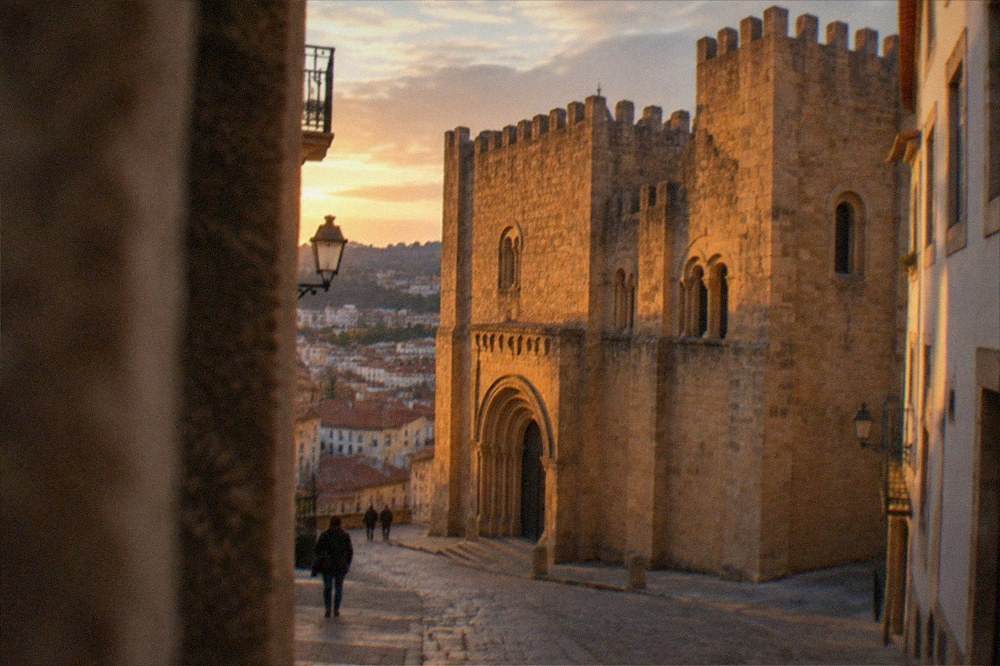
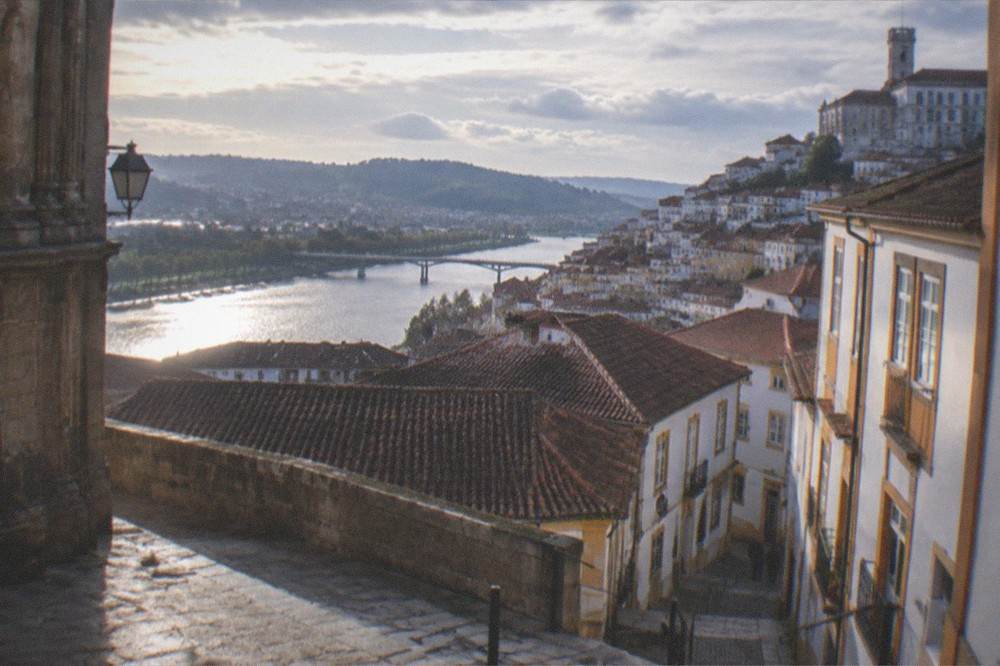
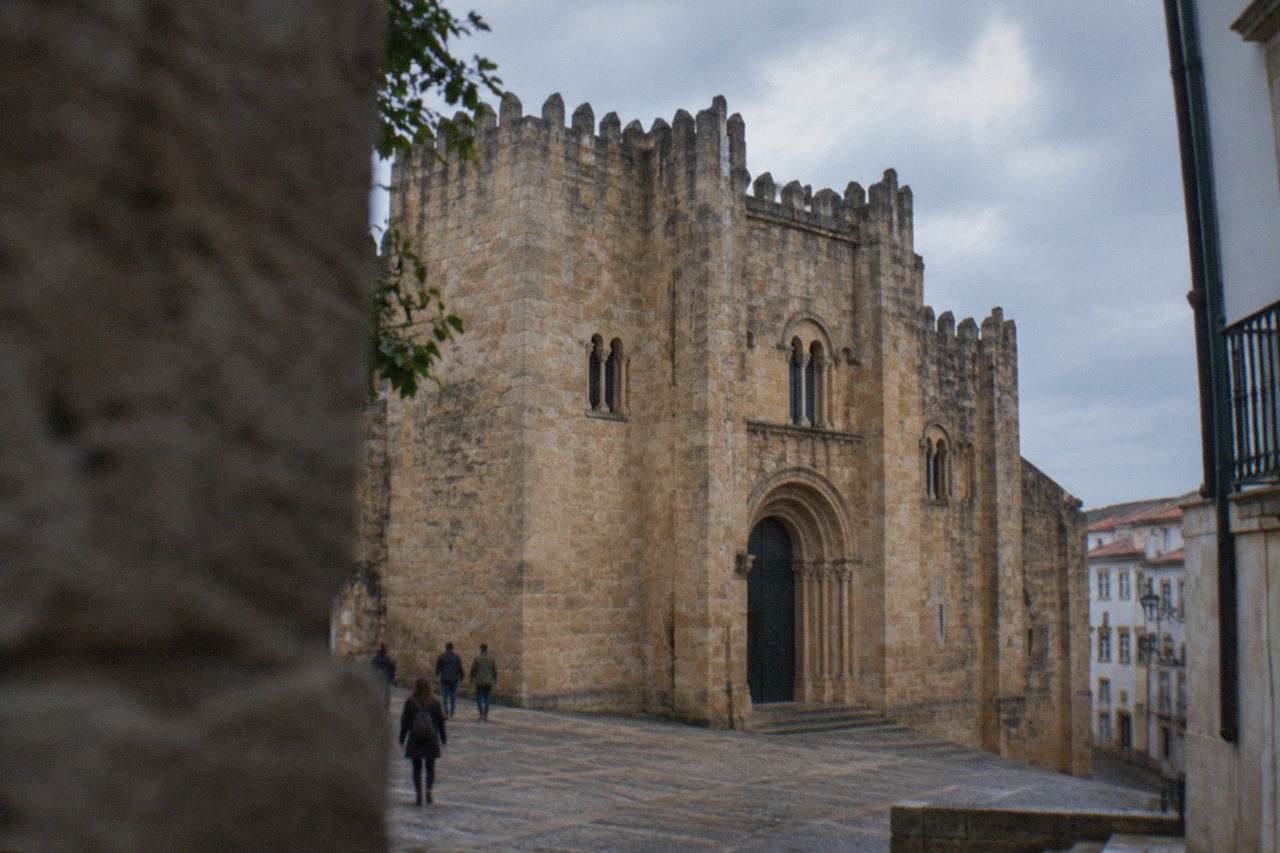
The Sé Velha, the old cathedral of Coimbra, Portugal, is the city's most fortress-like church: a heavy, crenellated block of stone standing on the upper lip of the old town, a few minutes' walk downhill from the university gates and looking out over the River Mondego. It is one of the few major monuments in the city whose prices and hours are published by the body that actually runs it, the Unidade Pastoral Aeminium, which manages both this cathedral and the Mosteiro de Santa Cruz across the square. That makes it unusually easy to plan around, and this guide sets out exactly what that parish publishes, what the ticket covers, and how to fit the visit into a day on the hill.
How Much Does It Cost to Visit the Old Cathedral of Coimbra?
An individual ticket to the Sé Velha costs 3.00 EUR per person, and groups of more than 10 people pay 2.50 EUR per person. Those prices come from the Unidade Pastoral Aeminium, the parish body that manages the cathedral and publishes its visitor information. There is no separate ticket tier listed for children, seniors or students on the parish's page, so the 3.00 EUR individual rate is the figure to budget for every adult in your party.
Three euros makes the Sé Velha one of the cheaper major monuments on the hill. For comparison, the Mosteiro de Santa Cruz charges 5.00 EUR per person, and the University of Coimbra's combined ticket that includes the Biblioteca Joanina is 16.50 EUR. If you are building a budget for a full day of monuments in the old town, the cathedral is one of the smallest line items on it.
| Monument | Individual adult ticket | Group rate | Source of the figure |
|---|---|---|---|
| Sé Velha (Old Cathedral) | 3.00 EUR | 2.50 EUR per person, groups over 10 | Unidade Pastoral Aeminium |
| Mosteiro de Santa Cruz | 5.00 EUR | 3.50 EUR per person, groups of 12 or more | Unidade Pastoral Aeminium |
| University of Coimbra, with Biblioteca Joanina | 16.50 EUR | Discount tiers listed on visit.uc.pt | University of Coimbra |
| University of Coimbra, without Biblioteca Joanina | 12.50 EUR | Discount tiers listed on visit.uc.pt | University of Coimbra |
| Museu Nacional de Conímbriga (ruins and museum) | 10.00 EUR | Discounts under national rules | Museus e Monumentos de Portugal |
Two of the entries in that table deserve a caveat. The Conímbriga ticket buys you a site roughly 16 km south of the city, in Condeixa-a-Velha in the municipality of Condeixa-a-Nova, so it belongs in a day-trip budget rather than a city-centre one. And the two university tickets are stamped on the University's own visit pages as valid for the 2026 season, with the Joanina version carrying a fixed timed slot that we will come back to, because it is the single most important booking fact in Coimbra.
What Are the Sé Velha's Opening Hours?
The Sé Velha keeps seasonal hours: 09:30 to 18:30 in summer and 09:30 to 17:30 in winter, with Sundays running 11:00 to 17:30 all year. Those are the hours published by the Unidade Pastoral Aeminium, the parish that manages the building. The one exception that matters is that the cathedral is a working church, and visits are not possible during religious services, so the published hours are a window rather than a guarantee.
The seasonal split means the same visit can feel very different depending on when you travel. In the long days of the Coimbra summer, an early-evening visit after the day-trippers have thinned out is realistic, because the door stays open until 18:30. In winter the building closes a full hour earlier, at 17:30, which matters more than it usually would here: the hill gets dark early, and the cathedral is one of the few interiors on the upper town worth being inside when the light goes.
| Period | Monday to Saturday | Sunday |
|---|---|---|
| Summer season | 09:30 to 18:30 | 11:00 to 17:30 |
| Winter season | 09:30 to 17:30 | 11:00 to 17:30 |
Sunday hours start later everywhere on the hill, and that is a pattern rather than an accident. The University of Coimbra's visitor circuit opens at 09:00 year-round, but the Mosteiro de Santa Cruz runs a separate Sunday and religious-holiday schedule of its own, with visits from 13:00 to 17:00 on those days. If your trip includes a Sunday, the practical sequence is the university first, the Sé Velha from 11:00, and Santa Cruz after lunch.
The other thing to hold in mind is the calendar of closures. The parish suspends visits on specific religious dates, and the University closes its own visitor circuit entirely on 24 May and 4 October in the current cycle, dates that line up with the academic calendar's biggest ceremonies. The Cortejo da Queima das Fitas, the student parade that fills the old town on a moveable Sunday in May, closes Santa Cruz for the whole day, and it transforms the square around the Sé Velha as well. Planning a quiet cathedral visit for that particular Sunday is a mistake; the whole upper town is a parade route.
A guided walk is one way to handle the hill's geography without thinking about it, and the Coimbra Top Attractions Walking Tour covers the cathedral alongside the other landmarks on the upper town circuit in about two and a half hours. The operator's live listing carries the current price and departure times.
What do You See Inside the Sé Velha?
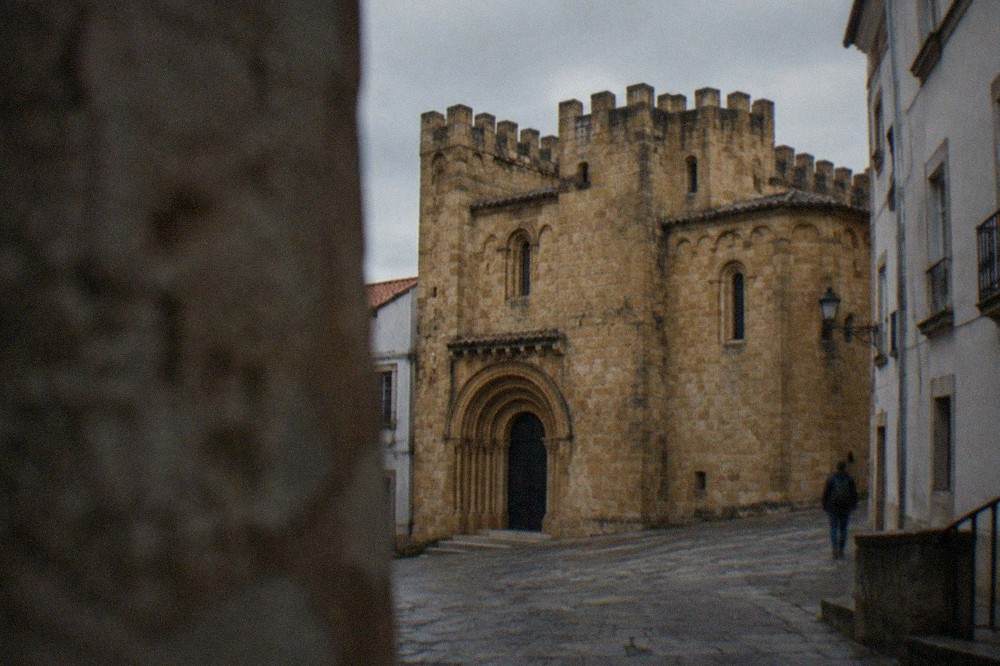
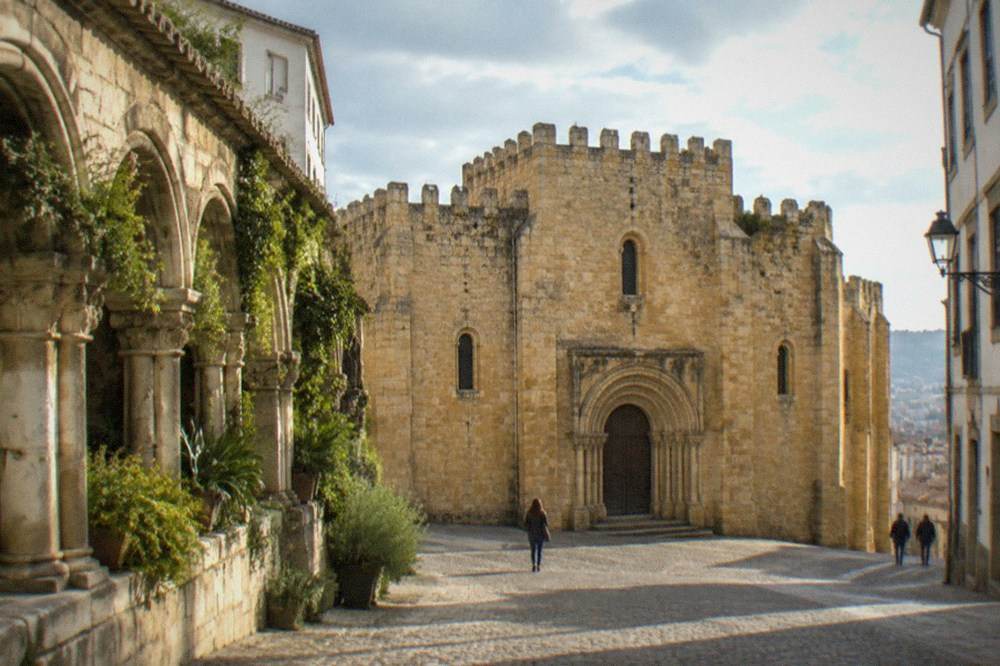
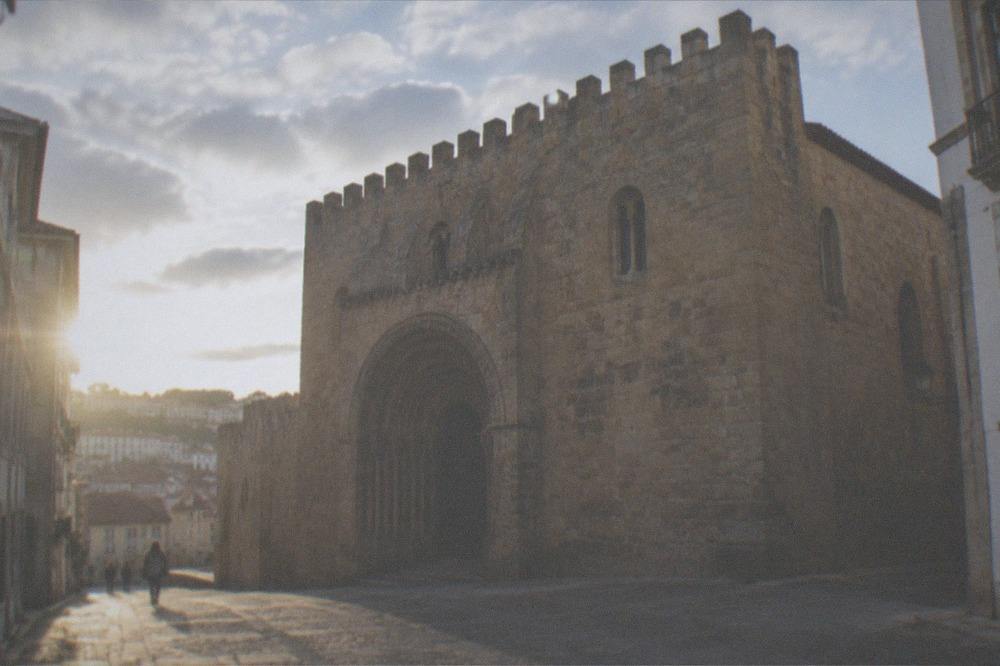
The Sé Velha's interior is compact and dark, centred on its nave, its cloister and its chapel of São Miguel, and the whole visit is comfortably done in 30 to 45 minutes at a normal pace. The building's fortress character is not incidental: crenellations run along its exterior walls, and the cathedral was clearly built to be defended as well as worshipped in, which is the feature that separates it most from the city's later churches.
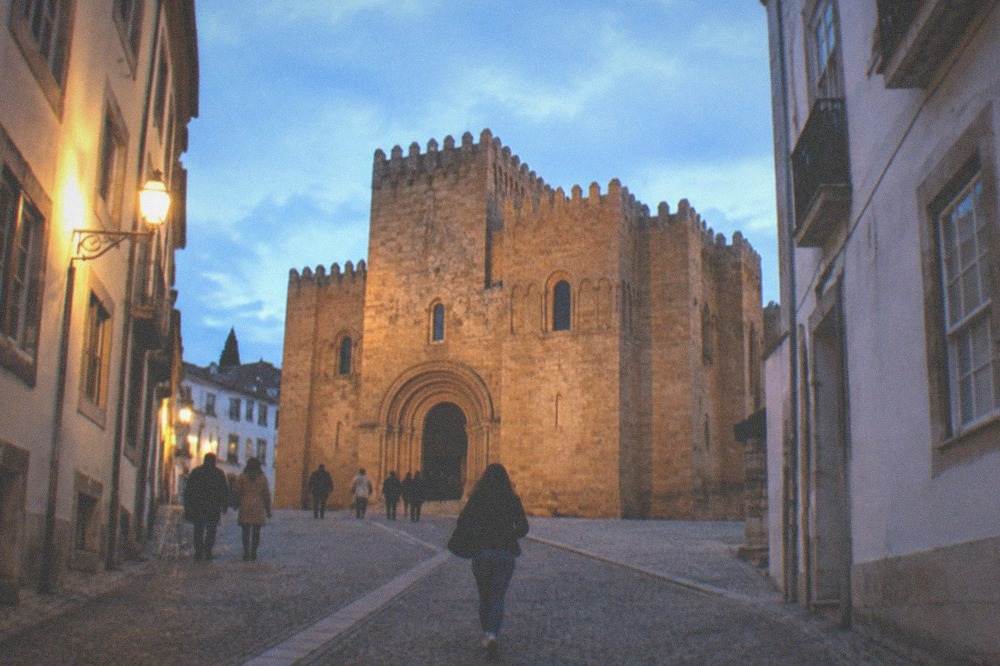
The fortress look is the thing most visitors comment on first. Where most cathedrals announce themselves with towers and portals, this one presents a wall of stone with the stepped battlements of a castle, and the small square in front of it leaves nowhere to stand back and take the whole façade in. That is a fair picture of the old upper town generally: the old town of Coimbra is dense, vertical and built for defence, and the cathedral is its most complete expression.
Inside, the sequence is short but concentrated. The nave leads to the cloister, and the cloister is the part people stay longest in, because it is one of the few quiet green spaces on this side of the hill. From the upper levels of the old town the views open out over the River Mondego and the Santa Clara district across the water, and the stretch of wall near the cathedral is one of the places where that panorama is closest to hand.
A note on what this guide deliberately does not tell you. The verified research behind this site, drawn from the parish's own pages and official monument listings, does not include a foundation date, a building campaign or an architectural period for the Sé Velha, and this site does not publish historical dates it cannot source. Plenty of guides will hand you a century and a style. What can be said with confidence is structural and comparative: this is the old cathedral of Coimbra, it was succeeded as the city's cathedral by the Sé Nova, and the two buildings bracket the city's ecclesiastical history between them.
That pairing is worth planning around. The Sé Nova, the new cathedral, sits a few streets away on the same upper slope, and visiting both in one walk makes the contrast legible in a way neither building manages alone. This site has not verified hours or prices for the Sé Nova, so check before you count on it, but the pair belongs in the same half-day.
How do You Fit the Sé Velha Into a Day in Coimbra?
The practical sequence for most visitors is university first, cathedral second, Santa Cruz third: the University of Coimbra's visitor circuit opens at 09:00, the Sé Velha from 09:30, and the Mosteiro de Santa Cruz keeps hours of 09:30 to 16:30 on weekdays, so a morning on the hill covers all three with time for the walk down through the Arco de Almedina afterwards. Budget roughly half a day for the upper town and the descent into the Baixa.
The order matters because of the Biblioteca Joanina. The library cannot be bought on its own; it exists only inside the 16.50 EUR combined ticket, and the time printed on that ticket is the fixed entry slot for the library specifically. The University's own program page states the limit plainly: 50 people every 20 minutes, with entry outside the printed slot refused. Online purchase closes 20 minutes before the visit time. Everything else on the university ticket is valid for two days, but the Joanina slot is not movable, so you build the morning around it and slot the cathedral in before or after.
| Stop | Opens | Ticket | Time to allow |
|---|---|---|---|
| University of Coimbra, Paço das Escolas | 09:00, summer and winter schedules from visit.uc.pt | 16.50 EUR with Joanina, 12.50 EUR without | 2 to 3 hours |
| Sé Velha | 09:30, seasonal close 17:30 or 18:30 | 3.00 EUR | 30 to 45 minutes |
| Mosteiro de Santa Cruz | 09:30 to 16:30, separate Sunday schedule | 5.00 EUR | 45 minutes to 1 hour |
| Descent through Arco de Almedina to the Baixa | Always open | Free | 15 to 20 minutes at a stroll |
The descent is the reward. The Arco de Almedina, the old gate in the city wall, funnels you down the stepped lane into the lower town, and by the time you reach the bottom the whole vertical geography of the city has explained itself. Going the other way, up from the Baixa, is the version that catches people out: the climb from the river to the cathedral square is steep, and in August, the hottest month in Coimbra's climate record with a mean maximum of 29.1 C and 10.9 days above 30 C, it should be done early.
Is the Sé Velha Part of Coimbra's UNESCO World Heritage Listing?
No, the Sé Velha is not itself part of the UNESCO inscription. What UNESCO listed in 2013, under the name "University of Coimbra – Alta and Sofia", list reference 1387, is two components inside the old town: the university hill and the college street below. The cathedral is not among the named components, and the common claim that Coimbra is a UNESCO World Heritage city is wrong: the property belongs to the university, not to the city as a whole.
That distinction is worth getting right because it changes what you expect from the hill. The inscribed property includes the Royal Palace of Alcáçova, the Capela de São Miguel, the Biblioteca Joanina, a series of colleges on the Rua da Sofia and the 1940s University City expansion, managed by an association called RUAS founded by the University, the City Hall, the culture ministry's regional delegation and Coimbra Viva. The Sé Velha stands in the middle of all that, physically continuous with the inscribed zone, but its listing status is its own.
The practical consequence is small and the intellectual one is large. Nothing about the cathedral's ticket, hours or access changes. What changes is the sentence you should not write: guides that call Coimbra a World Heritage city are describing a thing that does not exist, and the city's own tourism conversation is better served by the accurate version, which is that the university's hill and college street carry the inscription under criteria (ii), (iv) and (vi).
What Is Closed in Coimbra Right Now?
Two major monuments near the Sé Velha are closed for works as of September 2026: the Museu Nacional de Machado de Castro is closed for conservation work, and the Mosteiro de Santa Clara-a-Velha has been closed for requalification since 20 October 2025. Neither has a published reopening date on an official page, and no ticket price should be trusted for either until their own sites say otherwise. The Sé Velha itself is open under its normal published hours.
The Machado de Castro trap is worth spelling out, because the museum's own page sets it. That page carries the closure notice twice, and then prints a normal-looking opening-hours table directly below it. Anything that reads the page quickly will publish the hours. The hours are for whenever the museum reopens; they are not current. What the museum's own material does confirm is that it sits above a Roman cryptoporticus of the mid-1st century, one of the oldest structures in the city, at Largo Dr. José Rodrigues.
| Monument | Status as of September 2026 | What you can rely on |
|---|---|---|
| Sé Velha | Open, seasonal hours | Parish-published prices and hours |
| Mosteiro de Santa Cruz | Open, visits suspended on Easter Sunday and the Cortejo da Queima das Fitas | Parish-published prices and hours |
| Museu Nacional de Machado de Castro | Closed for conservation work | Closure notice on the museum's own page; no reopening date published |
| Mosteiro de Santa Clara-a-Velha | Closed for requalification works | No official page currently lists it as visitable; check before planning |
| Torre da Universidade | Closed, per the University's own information page | The University states the facility is closed; no climb is sold |
| Portugal dos Pequenitos | Open, seasonal hours from the venue's own page | Hours published; prices render client-side, so use the venue's ticket page |
The Machado de Castro museum sits a short walk downhill from the cathedral, and first-time visitors routinely have it on a list that no longer works. The honest planning advice is to build the upper town around the cathedral, Santa Cruz and the university, and to treat the museum as a bonus that will reappear once its own page drops the closure notice. The Santa Clara-a-Velha monastery, across the river, is in the same category: this site publishes no price and no hours for it, because no official page currently provides them.
Families should note one planning option that does work. Portugal dos Pequenitos, the miniature village run by the Fundação Bissaya Barreto, publishes hours of 10:00 to 19:00 from 1 March to 15 October and 10:00 to 17:00 in the winter shoulder, and it is one of the few attractions in the region with genuinely long summer days. Its ticket prices are not published on this site because the venue's own price page renders its table client-side, so use the venue's own ticket page for current figures.
When Is the Best Time of Day to Visit the Old Cathedral?
The best time to visit the Sé Velha is mid-morning on a weekday, after the 09:30 opening and before the midday tour groups arrive, or in the late afternoon during the summer season when the door stays open until 18:30. IPMA's 1991 to 2020 normals for the Coimbra / Bencanta station show July and August as the hot months, with August the hotter of the two, so in high summer the early slot wins and the climb up the hill should happen before the heat builds.
The climate record is more specific than most visitors expect, and it is the city's own station, not a regional proxy. August averages a mean maximum of 29.1 C against July's 28.5 C, and it averages 10.9 days above 30 C. September, by contrast, is the quiet season's secret: its mean maximum of 27.4 C is actually higher than June's 26.3 C, and it still gets only 49.9 mm of rain against October's 114.5 mm. The crowds leave in September and the weather does not.
| Month | Mean maximum (C) | Rain (mm) | Days of 1 mm+ rain |
|---|---|---|---|
| June | 26.3 | 26.0 | 3.7 |
| July | 28.5 | 8.9 | 1.7 |
| August | 29.1 | 14.8 | 2.2 |
| September | 27.4 | 49.9 | 5.2 |
| October | 23.2 | 114.5 | 10.3 |
What that table means for a cathedral visit is simple. In June, July and August, go early: the building is stone, unairconditioned and dark, and the walk up to it is the hardest part of the day. In September, any time works, and the late-afternoon slot in the 18:30 closing window is the most pleasant version of the visit. From October onwards the rain arrives, 114.5 mm in the month against September's 49.9, and the interior becomes the point rather than the view.
Can You Visit the Sé Velha on a Walking Tour?
Yes, the Sé Velha appears on several guided walks in Coimbra, including the Coimbra Top Attractions Walking Tour, a paid two-and-a-half-hour walk rated 5 from 151 reviews, and on the city's free, tip-based GuruWalk tours, which this site lists separately because they are pay-what-you-want rather than a booked product. A guided walk does not change the cathedral's own 3.00 EUR admission, which is paid at the monument regardless of how you arrive.
The walking-tour option solves the hill's one real difficulty, which is orientation rather than distance. The upper town is a stack of lanes, staircases and viewpoints, and a guide who walks it daily turns a morning of map-checking into a sequence. The paid options in this site's roster range from a 5.85 EUR budget walk up to private tours at 81.95 EUR and beyond, and the free GuruWalk walks, which must be named as such because they are tip-based rather than free products in the ordinary sense, cover the same ground with a local guide.
For visitors whose real priority is the university, there is a case for splitting the day. The University of Coimbra attractions deserve their own guided treatment, because the Joanina's timed slot and the Paço das Escolas circuit reward a guide who knows the building, and a university-focused tour leaves the cathedral to be done independently at your own pace either side of it.
A university-focused guided visit and a cathedral visit are not in competition; they are the two halves of a good morning. The skip-the-line university tour handles the Joanina slot and the Paço das Escolas, and the Sé Velha, three euros and no booking required, fills whatever gap the timetable leaves. Visitors travelling with children often swap the second monument of the morning for the miniature village instead, and the family options below cover that trade.
Common Questions About the Old Cathedral of Coimbra
How much is the Sé Velha in Coimbra?
The Sé Velha, the old cathedral of Coimbra, Portugal, charges 3.00 EUR per person for an individual ticket, and 2.50 EUR per person for groups of more than 10. Those figures are published by the Unidade Pastoral Aeminium, the parish body that manages the cathedral.
What are the opening hours of the old cathedral of Coimbra?
The Sé Velha is open 09:30 to 18:30 in summer and 09:30 to 17:30 in winter, with Sunday hours of 11:00 to 17:30 all year. Visits are not possible during religious services, so treat the published hours as a window rather than a guarantee.
Is the Sé Velha part of the UNESCO World Heritage listing?
No. The UNESCO inscription, "University of Coimbra – Alta and Sofia", listed in 2013 under reference 1387, covers the university hill and the Rua da Sofia college street, not the whole city and not the cathedral. The claim that Coimbra is a UNESCO World Heritage city is a common error.
How long does a visit to the Sé Velha take?
The interior, cloister and chapel are compact, and a visit at a normal pace runs about 30 to 45 minutes. Allow more time if you want to linger in the cloister or use the square and nearby wall for views over the River Mondego.
Can you visit the Sé Velha during mass?
No, visits are suspended during religious services. The cathedral is a working church run by the Unidade Pastoral Aeminium, and the published visiting hours sit around the liturgical schedule rather than overriding it.
Is the Machado de Castro museum near the Sé Velha open?
No. The Museu Nacional de Machado de Castro is closed for conservation work as of September 2026, and its own page carries the closure notice twice. No reopening date or current ticket price is published on an official page, so check the museum's own site before planning around it.
The Sé Velha rewards a slow look more than a long one. Three euros, half an hour and a working pair of legs get you one of the most distinctive church interiors in Portugal, standing at the top of a city whose whole character, student traditions and all, is built on the hill it sits on. Arrive early in summer, mind the service schedule, and pair it with Santa Cruz across the square for the full picture of what this parish looks after. For everything else on the slope, from the Joanina's 50-per-20-minute slots to the lanes down through the Arco de Almedina, this Coimbra Travel Guide has a dedicated page, and the old cathedral is the best place to start.