What's the Prettiest City in Portugal?
Coimbra, Portugal, is the city most often named the country's prettiest: the university hill, the Biblioteca Joanina, the Sé Velha and the River Mondego, with verified prices, hours and climate data.
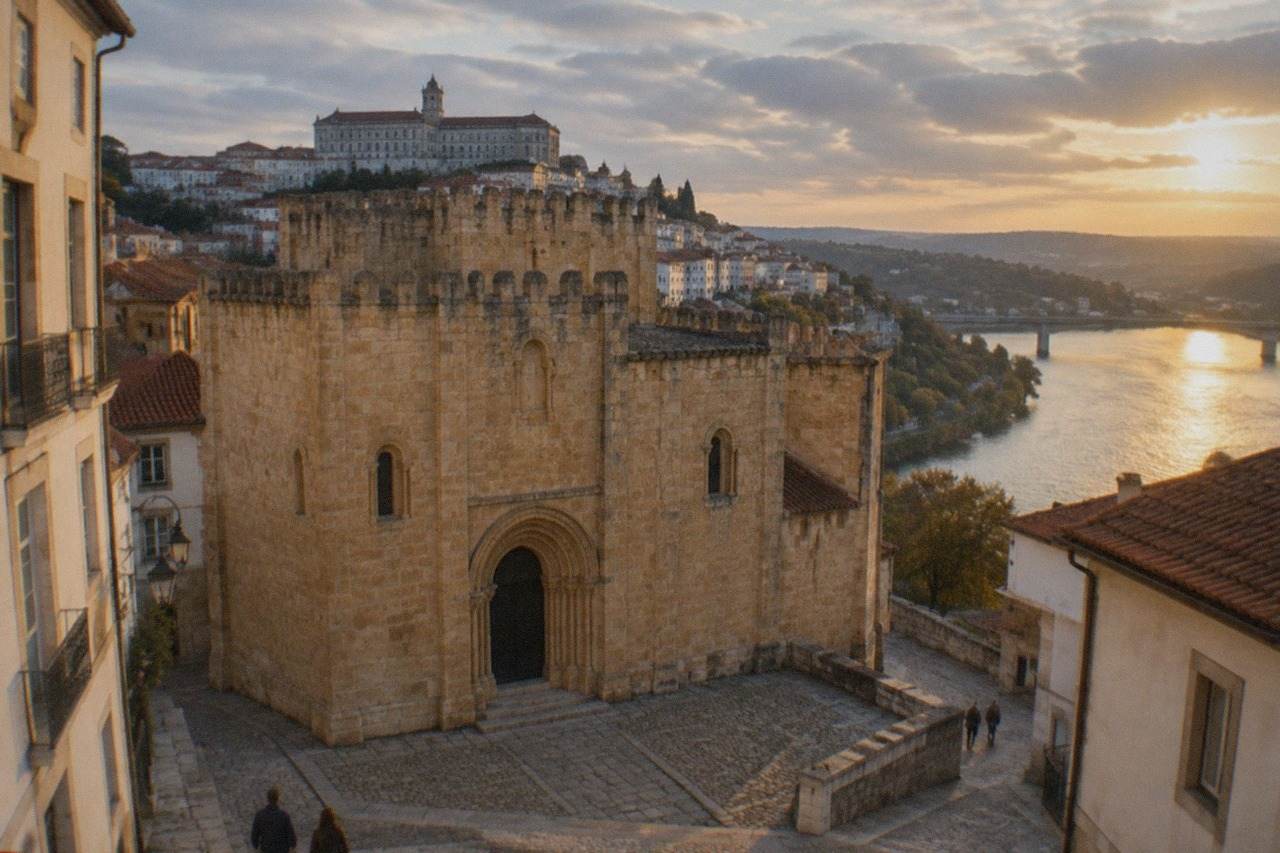
The prettiest city in Portugal, in the judgement of most people who have walked both, is Coimbra, the university city on the River Mondego in the Centro region. Coimbra is not the largest Portuguese city, and it is not the most visited; those superlatives belong elsewhere and no official body has ever measured beauty. What Coimbra has is a hill. The University of Coimbra, one of the oldest in continuous operation, sits on top of it, and the whole old town falls away below toward the river in a stack of colleges, churches and tiled facades. The UNESCO World Heritage List inscribed "University of Coimbra – Alta and Sofia" in 2013, criteria (ii), (iv) and (vi), covering the university hill and the college street below, not the entire city, and that precision matters: the inscribed core is what people photograph and call beautiful.
What's the Prettiest City in Portugal?
The honest answer is that no official ranking exists, but the case most often made, and the one this site's own verified data supports best, is Coimbra, Portugal: a city of about 31,000 students, a 2013 UNESCO inscription covering its university hill and college street, a baroque library admitting 50 people every 20 minutes, and two cathedrals facing each other across the old town. Beauty is a judgement, not a measurement, so what follows is the evidence rather than a verdict.
Nobody has ever published a measured ranking of Portuguese cities by beauty, and any guide that claims one is inventing it. What can be done honestly is to lay out what Coimbra objectively holds, and let a reader compare it with what they already know of Porto, Lisbon, Braga or Aveiro. The University's own homepage publishes its current figure of about 31,000 students, which means roughly a fifth of the city's population is tied to the institution on the hill. That single fact explains the look of the place: the black-caped students, the Repúblicas, the fado sung by men rather than women, the whole atmosphere that separates Coimbra from every other Portuguese city.
The municipality publishes its own tourism numbers, and they are worth knowing before repeating any claim about which city is "most visited". Coimbra recorded 698,151 overnight stays in 2025, a municipal figure, not a district one. That is a fraction of what Lisbon and Porto record, which is precisely the argument for beauty: the prettiest city in the country is also one you can still walk through without a crowd in front of every doorway. For more on what makes the place distinctive, see what is special about Coimbra Portugal.
Why do People Call Coimbra Portugal's Most Beautiful City?
People call Coimbra the most beautiful city in Portugal because of a single, walkable composition: the Paço das Escolas on the hilltop, the Biblioteca Joanina inside it, the Sé Velha and Sé Nova a few streets below, and the River Mondego cutting the view in two. The University's own visit pages list a 16.50 EUR combined ticket covering the library, the Royal Palace, St Michael's Chapel and the science collections, all inside the inscribed hill.
The Biblioteca Joanina is the piece that decides the argument for most visitors. It is a baroque library finished in the 18th century, and the University's own rules describe its constraint exactly: entry is limited to 50 people every 20 minutes, the ticket cannot be bought alone, it exists only inside the 16.50 EUR combined ticket, and the time printed on the ticket is the library slot specifically. Entry outside the printed slot is refused. A colony of bats lives in the library and eats the insects that would otherwise damage the books, a fact the University states on its own space page. There is no other room like it in the country, and the scarcity is real: slots sell out, and a visitor who arrives in summer without a pre-booked time can be turned away.
Below the library, the hill keeps delivering. The Sé Velha de Coimbra, the old cathedral, charges 3.00 EUR for an individual ticket, per the parish body that manages it, and the Sé Nova, the new cathedral, stands a short walk away; its page on this site covers Sé Nova New Cathedral. The Mosteiro de Santa Cruz, the burial church of Portugal's first two kings, charges 5.00 EUR for an individual visit. The table below is every headline monument with a price this site has verified from a primary source.
| Monument | What it is | Verified adult price | Source level |
|---|---|---|---|
| Biblioteca Joanina + University + Science Museum | Baroque library, Royal Palace, St Michael's Chapel, science collections | 16.50 EUR | University's own visit pages |
| University + Science Museum | Same circuit without the library | 12.50 EUR | University's own visit pages |
| Sé Velha de Coimbra | Romanesque old cathedral | 3.00 EUR | Parish management body |
| Mosteiro de Santa Cruz | Burial church of the first two kings | 5.00 EUR | Parish management body |
| Museu Nacional de Conímbriga | Roman ruins and museum, about 16 km south | 10.00 EUR | National museums portal |
One monument is missing from that table on purpose. The Museu Nacional de Machado de Castro is closed for conservation work, per its own page on the national museums portal, so no current price exists to publish. The Torre da Universidade, the clock tower, is also closed; the University's own information page states the facility is closed, and the 184 steps and narrow passage it mentions explain why a reopening is not simple. Any guide offering you a tower climb or a Machado de Castro ticket today is selling something that does not exist.
What Makes Coimbra's Old Town So Photogenic?
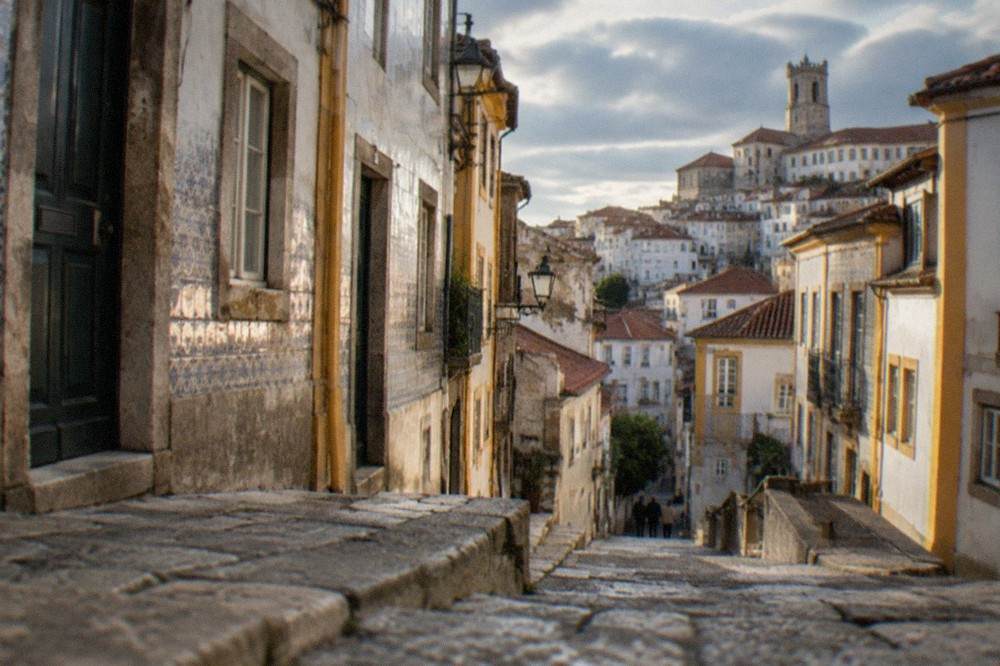
Coimbra's old town is photogenic because it is vertical: the Alta, the upper town, holds the university and the cathedral quarter, and everything below spills down to the Baixa and the river through lanes like the Arco de Almedina, with the city's two halves linked by stairs, the Elevador do Mercado and a funicular-railway lift. The inscribed UNESCO property covers the Alta and the Rua da Sofia colleges, so the protected beauty is concentrated in a walkable core.
The geography does the work. Porto is beautiful along a river gorge, Lisbon is beautiful across seven hills, but Coimbra is beautiful in one continuous frame: you stand on the university terrace and the whole city is below you, the Mondego beyond it. The Alta upper town is where that frame is composed, and the Baixa downtown is the low commercial quarter that gives the city its everyday life, its cafés and its covered market streets. Between them runs the drop that makes every photograph work.
The student layer adds what stone alone cannot. The Repúblicas, the centuries-old student houses, are painted, argued over and sung about; this site's guide to the Repúblicas student houses covers them in detail. The Elevador do Mercado, the hill lift, appears in the SMTUC 2026 tariff under a combined-pass line, though the operator publishes no standalone single-ride price, so this site does not print one. The lift exists, it runs, and it saves the climb; that is as far as a verified statement goes.
A guided visit is the efficient way to absorb the hill, and the University of Coimbra Guided Tour with Tickets is the one this page recommends: a former student leads a group of ten, admission is included, and the queue is handled for you. Check availability if the Joanina slot is the part of the day you most care about, because a tour with tickets included is the simplest way to guarantee one.
How Does Coimbra Compare with Porto, Lisbon and Braga?
Coimbra cannot be ranked against Porto, Lisbon or Braga on any measured scale, because no verified comparison exists: this build verified figures for Coimbra and Conímbriga only, and published nothing for any other city. What can be said honestly is structural: Lisbon has the scale and the light, Porto has the gorge and the wine, Braga has the churches, and Coimbra alone has a working university of about 31,000 students sitting on top of its beauty, which is why it looks lived in rather than staged.
Every comparison needs a source on both sides, and here only Coimbra has one. So instead of inventing a ranking, this site states what each city is and leaves the verdict to the reader. Lisbon is the capital, enormous, white and spread over hills. Porto is the northern port, built hard against the Douro, famous for its bridges and its lodges. Braga is the religious city, dense with baroque. Aveiro is the lagoon city, all art nouveau and salt. Évora and Tomar carry their own histories. None of those sentences contains a number, because none of those numbers was verified, and a pretty-sounding figure for another city is exactly how guides go wrong.
Coimbra's difference is the university. A city of about 31,000 students, published by the University itself, behaves differently in June than a city of tourists does: the academic calendar empties it, fills it, dresses it in black capes and fills the Sé Velha steps with song. The municipality's own 2025 figures, 698,151 overnight stays and an estimated municipal cost per overnight stay of 3.49 EUR against a one-euro tourist tax, describe a city that is busy but not overwhelmed. If prettiness includes being able to see the thing you came to see, that is part of the case. Readers weighing the alternatives can start with is Coimbra worth visiting for tourists.
When Is Coimbra at Its Most Beautiful?
Coimbra is at its most beautiful in late spring and September: IPMA's 1991 to 2020 normals for the Coimbra / Bencanta station show May at a 23.3 C mean maximum with 64.7 mm of rain, and September at 27.4 C with only 49.9 mm, while July at 8.9 mm is effectively dry and November, at 121.5 mm, is the wettest month of the year.
The climate table rewards a close read, because the obvious assumption about it is wrong. September is hotter than June, 27.4 C against 26.3 C mean maximum, and wetter too, 49.9 mm against 26.0 mm, so "September is drier than June" is false and this site will not print it. What is true and sourced: the autumn rain holds off until October, when the monthly total jumps from 49.9 mm to 114.5 mm. August, not July, is the hottest month, on both mean and mean maximum, and averages 10.9 days above 30 C. The record extremes at the same station are 41.2 C on 7 August 2016 and -4.3 C on 20 January 2017.
| Month | Mean max (C) | Rain (mm) | Days with 1 mm+ rain | Days max 30 C+ |
|---|---|---|---|---|
| May | 23.3 | 64.7 | 8.5 | 3.5 |
| June | 26.3 | 26.0 | 3.7 | 6.2 |
| July | 28.5 | 8.9 | 1.7 | 8.9 |
| August | 29.1 | 14.8 | 2.2 | 10.9 |
| September | 27.4 | 49.9 | 5.2 | 7.8 |
| October | 23.2 | 114.5 | 10.3 | 2.0 |
May carries one caveat the climate table cannot show. The University closes its visitor circuit on 24 May, and the Mosteiro de Santa Cruz suspends visits on the Cortejo da Queima das Fitas, a moveable Sunday, because the student festival takes over the city centre for the day. The festival is itself a spectacle, and this site's guide to Queima das Fitas covers what is officially verifiable about it; the exact dates are published by the Associação Académica, and this site does not print a number it has not read there. If the goal is quiet beauty, aim for late September: the students have returned, the heat has eased by a degree or two, and the October rain is still a month away.
Common Questions About the Prettiest City in Portugal
what's the prettiest city in portugal?
No official ranking exists, but the case most often made is Coimbra, Portugal: a UNESCO-inscribed university hill, the Biblioteca Joanina, two cathedrals and the River Mondego, all walkable in a day.
Is Coimbra a UNESCO World Heritage city?
No. UNESCO inscribed "University of Coimbra – Alta and Sofia" in 2013, covering the university hill and the Rua da Sofia colleges. The city as a whole is not inscribed, and guides that say otherwise are wrong.
Is Coimbra prettier than Porto or Lisbon?
That is a matter of taste, and no measured comparison exists. Porto has its river gorge, Lisbon its hills and light, and Coimbra its university hill and student atmosphere. This site publishes verified figures for Coimbra only.
What is the single most beautiful thing to see in Coimbra?
The Biblioteca Joanina, inside the University's 16.50 EUR combined ticket. Entry is limited to 50 people every 20 minutes and the printed ticket time is the library slot, so book ahead.
When should I visit Coimbra for the best weather?
May and September. IPMA's 1991 to 2020 normals show May at a 23.3 C mean maximum and September at 27.4 C, with the heavy autumn rain not arriving until October, when the monthly total jumps to 114.5 mm.
Is Coimbra crowded?
Less than the major cities: the municipality recorded 698,151 overnight stays in 2025, its own municipal figure. The one genuine bottleneck is the Joanina Library, whose 50-people-per-20-minutes ceiling is the real scarcity in the city.
Coimbra Travel Guide exists because the prettiest city in Portugal deserves a guide that only prints what a primary source confirms, and the hill, the library and the river will still be there when the reader arrives.