The Nearest Airport to Coimbra, Portugal: What to Fly Into and How to Get Here
Coimbra, the university city on the River Mondego in central Portugal, has no airport of its own. Every visitor flies into Porto, Lisbon or one of the smaller gateways and finishes the journey by train, coach or car, and the last leg is where the planning actually happens.

Short answer
Coimbra, Portugal has no commercial airport. Most visitors fly into Porto (OPO) or Lisbon (LIS) and complete the journey by train, coach or rental car. Coimbra has two railway stations with confusingly similar names, Coimbra-B and Coimbra-A, and CP, the national operator, is the place to confirm which trains stop where.
Coimbra, the university city on the River Mondego in central Portugal, does not have an airport. There is no field on the edge of town with a runway, no regional strip taking a daily hop from Lisbon, nothing. Every single visitor to this city arrives by finishing a journey that started somewhere else, and that is not a footnote to the trip, it is one of the main planning decisions. The city sits roughly midway between Porto and Lisbon on the country's main north-south rail spine, which is why the answer to "which airport" is less important than the answer to "and then what".
This page, maintained by the Coimbra Travel Guide editorial desk, sets out what is actually verified about getting to the city by air. Two warnings up front, because they matter. First, road distances and driving times from Porto airport and Lisbon airport to Coimbra are unsourced on this build: no official figure was found, and this site does not publish plausible-sounding numbers it cannot back. Second, the two railway stations, Coimbra-B and Coimbra-A, are a genuine trap, and which trains call at which station is likewise not something to guess at. Both points get their own sections below, with what can be said honestly and where to confirm the rest.
Does Coimbra, Portugal Have Its Own Airport?
No, Coimbra has no airport of its own, and never has had a commercial one in the modern era. The city is served entirely by gateways elsewhere in Portugal, principally Porto (OPO) and Lisbon (LIS), with the final leg made by train, coach or car. Nothing flies into Coimbra itself, so the flight is only ever the first two-thirds of the journey, and the last third is where the planning effort belongs.
That sounds like an inconvenience. In practice it is close to irrelevant, because Coimbra sits on the Linha do Norte, the main rail artery connecting Lisbon and Porto, and the long-distance services of CP, Comboios de Portugal, stop in the Coimbra area. The city's own published identity reinforces how central it is: the University of Coimbra publishes a figure of about 31,000 students on its homepage, and a city that size, mid-way between the country's two biggest metropolitan areas, was always going to be wired into the rail network rather than the air network.

There is a small aerodrome in the wider region, and the district of Coimbra, which is a different thing from the city, stretches west to the Atlantic. None of that adds up to a scheduled passenger flight you can book into this city. If a search result promises a "Coimbra airport" with arrivals and departures, it is describing something that does not exist as a passenger gateway.
For everything that happens after the wheels touch down, the practical pages on this site carry the detail: the Porto to Coimbra journey, the Lisbon to Coimbra journey, and the airport transfers overview each go deeper than this page can.
Which Airport Should You Fly Into for Coimbra?
Porto (OPO) and Lisbon (LIS) are the two realistic gateways, and the choice between them usually comes down to where you are flying from, what the onward plan is, and which fare wins on the day. Neither is "the Coimbra airport"; both are large international hubs with full short and long-haul networks, and both connect onward to Coimbra by rail and coach. There is no sourced reason to declare one universally closer in time, so treat the decision as a fare and itinerary question, not a geography one.
Why no kilometre count here? Because road distances and driving times from either airport to Coimbra are unsourced on this build. Figures circulate freely online, but they come from distance-calculator sites, which are not acceptable sources for this site, and no official figure was verified. What can be said is structural and more useful anyway: Coimbra sits between the two cities on the main rail line, so the train is the natural finish from either direction, and CP's own timetables are where the actual journey time for your specific service lives.

A few honest decision points. If your itinerary includes the Douro, Braga or the Minho, Porto makes sense as the entry point. If it starts in Lisbon, Sintra or the Alentejo, Lisbon does. If Coimbra is the whole trip, compare the total door-to-door cost of both options, flight plus onward ticket, rather than the flight alone, because a cheap flight into the "wrong" airport can still win once the rail fare is counted.
Once you are here, the Coimbra travel guide overview collects the practical pages, and things to do in Coimbra covers the reasons you came.
Coimbra-B or Coimbra-A: Which Train Station do You Arrive At?
Coimbra has two railway stations with confusingly similar names, Coimbra-B and Coimbra-A, and they are in different places. Which long-distance trains call at which station is not something this site can state from a verified source, and neither is the question every visitor actually asks: whether the shuttle between them is free with a long-distance ticket. CP, Comboios de Portugal, is the operator, and its passenger site is the only place to confirm the stopping pattern and the connection before you travel.
That is a deliberately restrained answer, and the restraint is the point. During this site's research pass, three CP station URLs answered with HTTP 200 status codes while the page bodies read "Page not found", a soft-404 behaviour that makes status checks worthless on that host. Plenty of guides confidently state which services stop at Coimbra-B, how long the hop down to Coimbra-A takes, and that the shuttle is included in your ticket. None of that could be confirmed here, so none of it appears on this page. The dedicated Coimbra train stations A and B guide carries the same honest line.
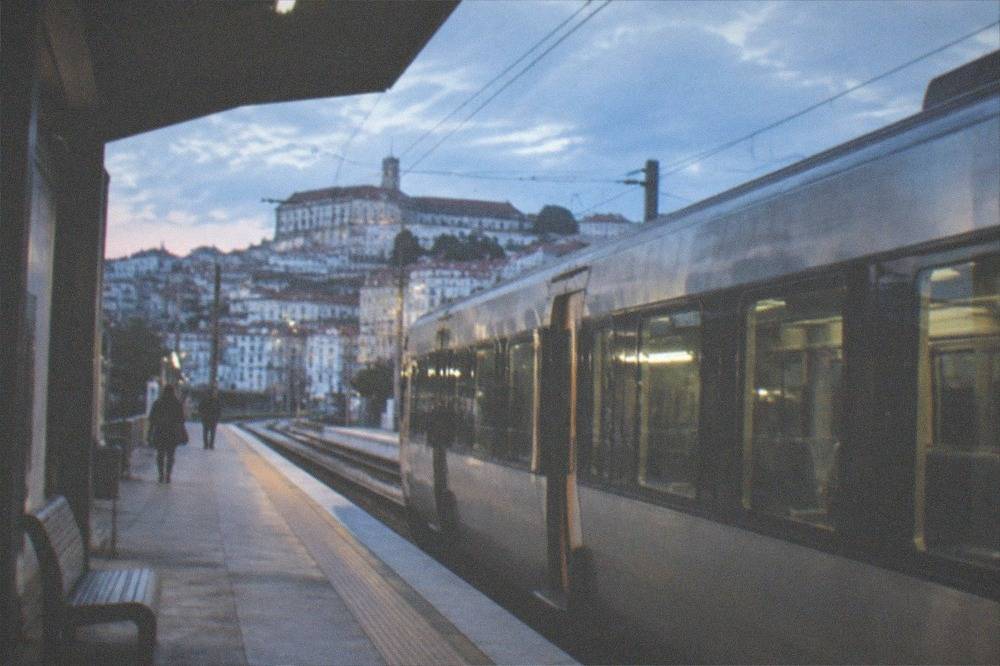
What a visitor can safely plan around: two stations exist, the names differ by a single letter, and checking your specific train's stopping pattern on CP's own site before departure takes two minutes and removes the guesswork entirely. If your ticket shows Coimbra-B and you expected the riverside, or vice versa, you have not made a mistake, you have just met the city's one genuinely confusing transport quirk.
Once you are off the train and standing in the city, the Coimbra map page orients you, and the getting around options cover the local network.
How do You Get from the Airport to Coimbra Without a Car?
The realistic car-free options are the long-distance train from Porto or Lisbon into the Coimbra stations, the intercity coach networks running from both cities, and a pre-booked private transfer from either airport door to your accommodation. All three end at the same place, and the choice is a trade between price, luggage and schedule. The train is the default for most visitors because Coimbra sits directly on the main line, but the coach wins for some departure times and the transfer wins for late arrivals with bags.
The car-free case for Coimbra is unusually strong, and the reason is the rail geography above. Add the city's own scale: the old town is compact, steep and largely pedestrian, so a rental car is a liability for the visit itself even where it helps the arrival. The car rental in Coimbra guide exists for the itineraries that genuinely need wheels, the Fátima shrine run, the schist villages of the Lousã, the Bairrada wine country, and it says so plainly.

Inside the city, the local operator is SMTUC, and its 2026 tariff, in force since 1 April 2026, is fully sourced, so it can be stated exactly:
| SMTUC ticket type | Price | Notes |
|---|---|---|
| Driver ticket, bought on board | 2.00 EUR | Single journey |
| Pre-purchased, 3 or more trips | 0.90 EUR per trip | Rechargeable card |
| One-trip validity | 90 minutes | Urban network, transfers included |
| Viagem ConVIDA support card | 0.50 EUR | For occasional and pre-purchased tickets |
| MOVE-C support card, youth | 3.00 EUR | Support card price |
| MOVE-C support card, others | 6.00 EUR | Support card price |
| Fare evasion fine | 120.00 to 350.00 EUR | Penalty range |
One extra detail from the same tariff document: SMTUC tickets are also valid on the Metro Mondego network, the new bus-rapid system that has been opening in stages across the city and out along the Mondego valley. A day ticket bought for the city bus therefore covers more than the city bus, which is worth knowing before you buy anything.
For arrival from the airports specifically, a pre-booked transfer removes the two-station question entirely, and the airport transfers guide compares the honest options without inventing prices the pack does not carry.
Is It Better to Fly Into Porto or Lisbon for a Coimbra Trip?
For a trip centred on Coimbra itself, the honest answer is whichever gateway your route and fare favour, because both connect onward by the same main rail line and neither has a verified advantage in distance or time. The tie-breakers that matter are the rest of your itinerary, your flight's arrival time, and whether you want a same-day connection or an overnight stop first. Many visitors split the difference: fly into one, out of the other, and see Coimbra mid-route.
That last pattern deserves its own paragraph, because it is what the geography quietly recommends. Coimbra sits between the two metros on the main line, so an open-jaw ticket, Lisbon in, Porto out or the reverse, turns the "which airport" question into a feature. You ride the spine of the country through Coimbra instead of doubling back, and the Porto to Coimbra and Lisbon to Coimbra pages each cover their own half of that journey.

Timing matters more than gateway choice. The University of Coimbra's visitor circuit runs on a summer schedule of 09:00 to 20:00 from 1 April to 30 September and a winter schedule of 09:00 to 17:30 from 1 October to 31 March, with full closures on 24 and 25 December, 31 December and 1 January, plus 24 May and 4 October for academic events. A flight that lands at dusk in winter, followed by a two-station connection, can cost you the first morning. The best time to visit Coimbra page works through the seasons in detail.
And the seasons genuinely differ here. The official IPMA climate normals for the Coimbra / Bencanta station, the city's own station, series 1991-2020, are worth reading before you book:
| Month | Mean max C | Rain mm | Days with 1 mm+ rain |
|---|---|---|---|
| June | 26.3 | 26.0 | 3.7 |
| July | 28.5 | 8.9 | 1.7 |
| August | 29.1 | 14.8 | 2.2 |
| September | 27.4 | 49.9 | 5.2 |
| October | 23.2 | 114.5 | 10.3 |
| November | 18.0 | 121.5 | 11.5 |
Two facts from that table surprise people. September is hotter than June, a mean maximum of 27.4 C against 26.3 C, and wetter too, 49.9 mm against 26.0 mm, so the "September beats June" claim has to be made carefully. The real sourced point is that the autumn rain holds off until October, when the monthly total jumps from 49.9 mm to 114.5 mm. August, not July, is the hottest month, averaging 10.9 days above 30 C.
What Does Getting to Coimbra Cost Beyond the Flight?
The costs you can plan in advance are the tourist tax, 1.00 EUR per guest per overnight stay, capped at three consecutive nights, charged from age 16 and paid to your accommodation, plus the monument tickets you book before you arrive, notably the 16.50 EUR University of Coimbra combined ticket that includes the Biblioteca Joanina. The 2026 SMTUC tariff gives exact city bus prices. What you cannot pre-price here is the airport transfer itself, because no sourced operator price exists on this build.
The tourist tax is the one visitors most often meet unprepared, so it gets its own table, drawn from the municipality's own service pages. The tax took effect on 5 April 2023, is charged all year with no low-season exclusion, and is not subject to VAT. A couple staying seven nights pays 3.00 EUR each, 6.00 EUR in total, because of the three-night cap. Exemptions exist for medical stays, one companion of a medical traveller, and guests with a disability of 60% or more, on production of a document; there is no exemption for professional travel, internships, students or research fellows.
| Tourist tax rule | Detail |
|---|---|
| Amount | 1.00 EUR per guest per overnight stay |
| Cap | Maximum 3 consecutive overnight stays per person |
| Minimum age | From age 16, birthday itself excluded, ID required |
| Where paid | Directly to the accommodation, at check-in or check-out |
| In force since | 5 April 2023 |
| Season | Charged all year |
| Worked example | Couple, 7 nights: 3.00 EUR each, 6.00 EUR total |
One genuinely local fact sits behind this tax, and almost no guide has it. The municipality's own economic justification, published in July 2026, reports 698,151 overnight stays recorded in Coimbra in 2025, a municipal figure, and estimates the municipal cost associated with tourism at 3.49 EUR per overnight stay. The one-euro tax sits well below cost, which is why the municipality's Executive approved a proposal on 21 July 2026 to raise it to two euros. That is a proposal, not the rate: the published figure remains 1.00 EUR until the municipality's own tax pages say otherwise, and this site will not print the two as current.
The monument budget is the other predictable block, and the verified prices are these:
| Ticket | Price | Notes |
|---|---|---|
| University of Coimbra combined, with Joanina | 16.50 EUR | Valid 2 days except the fixed Joanina slot |
| University of Coimbra, without Joanina | 12.50 EUR | Valid 2 days |
| Sé Velha de Coimbra, individual | 3.00 EUR | Old Cathedral |
| Mosteiro de Santa Cruz, individual | 5.00 EUR | Burial church of Portugal's first two kings |
| Conímbriga, museum and ruins combined | 10.00 EUR | Open daily 10:00 to 18:00, closed 24 July and 25 December |
| Guided Palace of Schools visit | 25.00 EUR | 1h30, guide-led |
Two closures matter to any budget built on that table. The Museu Nacional de Machado de Castro is closed for conservation work, its own page says so, and no reopening price is published on an official page, so nothing is listed here for it. The Mosteiro de Santa Clara-a-Velha has been closed for requalification works since 20 October 2025 and likewise carries no publishable price. The Torre da Universidade is closed too, per the University's own information page, so no tower climb is sold or described anywhere on this site.
Why the Joanina Library Slot Should Shape Your Arrival Day
The Biblioteca Joanina admits 50 people every 20 minutes, cannot be bought as a standalone ticket, and exists only inside the 16.50 EUR combined University ticket, where the time printed on your ticket is the library entry slot specifically, fixed and refused if missed. Online purchase closes 20 minutes before the visit time. That ceiling is the one genuine, verifiable scarcity in Coimbra, and it is the reason your arrival day and your library day should be planned together, not separately.
The University's own program page states the capacity rule verbatim: entries are limited to 50 people every 20 minutes. The rest of the combined ticket, the Royal Palace, St Michael's Chapel, the Chemistry Laboratory, the Academic Museum, the Cabinet of Curiosities and the Mineral Gallery, can be visited across two days, but the Joanina slot is the one fixed appointment in the whole ticket. A traveller who lands, reaches the city late, and discovers the next day's slots are gone has a two-day ticket with a hole in it.

This is where the airport question stops being abstract. Book the flight, then book the Joanina slot, then work backwards to the onward journey, in that order. The Joanina Library tickets guide and the University tickets guide walk through the tiers and the timing rules in full.
A guided visit removes some of that friction, because a guide with a group booking has already solved the slot problem for you. The roster on this site includes several, and the three below are the ones that pair naturally with an arrival-focused trip.
The Coimbra: Adventure, Discovery & Learning with a Local tour runs about three hours with a local guide and is rated 4.9 from 55 reviews, from $40 per person. It suits a first afternoon, when you have arrived, dropped bags, and want the city explained before you plan the rest. The tour has its own page at Coimbra: Adventure, Discovery & Learning with a Local, and you can Check availability for your dates.
Should You Rent a Car at the Airport for a Coimbra Trip?
For a trip that stays inside Coimbra and the Mondego valley, no: the old town is steep, largely pedestrian, and better served by the SMTUC network whose 2026 prices are published above. For a trip built on the schist villages of the Lousã, the Conímbriga ruins, the Bussaco forest or the Fátima shrine, a car earns its cost, and picking it up at Porto or Lisbon airport on arrival is the standard pattern. The honest line is that the car decision follows the itinerary, never the reverse.
The day-trip geography makes the case. Conímbriga, the Roman town, lies about 16 km south in the parish of Condeixa-a-Velha, in the municipality of Condeixa-a-Nova, and its museum and ruins take a single 10.00 EUR combined ticket, open daily from 10:00 to 18:00, which makes it the reliable Monday option when monuments that close on Mondays are shut. The schist villages of the Lousã sit in hill country to the east. The Bussaco forest and the Bairrada wine route spread south and west. None of that is walkable from a railway station, and all of it is why the day trips overview exists.

Where the car-free option wins, it wins completely, and the tours below are the proof: each one covers ground that would otherwise demand a vehicle.
The From Porto: Full-Day Trip to Coimbra & Aveiro with Boat Ride is the one product on this roster that solves the airport problem outright: it runs from Porto, from $114 per person, rated 4.7 from 106 reviews, and delivers Coimbra and the Aveiro lagoon in a single day. For a visitor flying into Porto with limited time, it converts the gateway city into the transport and the itinerary at once. See the full-day Porto, Coimbra and Aveiro trip page for dates and details.
The Coimbra Top Attractions Walking Tour, from $5.85 per person and rated 5 from 151 reviews over about two and a half hours, is the opposite answer: it assumes you have already arrived and spends its time on the city itself. It pairs well with the arrival day, when energy is high and the Joanina slot is still ahead. Details are on the Coimbra Top Attractions Walking Tour page, with live dates on the operator's listing.
For the evenings, when the arrival is done and the planning paid off, the where to hear fado in Coimbra page covers the city's own fado tradition, sung in the student costume rather than the Lisbon shawl, and the where to stay in Coimbra page settles the other half of the first night.
Common Questions About the Nearest Airport to Coimbra
Does Coimbra, Portugal have an airport?
No. Coimbra has no airport of its own and no scheduled passenger flights. Visitors fly into Porto (OPO) or Lisbon (LIS) and complete the journey by train, coach, transfer or rental car.
Which airport is closest to Coimbra?
Porto and Lisbon are the two realistic gateways. This site does not publish a road distance or driving time for either, because no official figure was verified; Coimbra sits between the two cities on the main north-south rail line, and CP's timetables are the place to compare actual journey times for your specific service.
Which train station does Coimbra have, Coimbra-A or Coimbra-B?
Both exist and they are in different places. Which long-distance trains call at which station is unsourced on this build, and so is whether the shuttle between them is free with a long-distance ticket. CP, Comboios de Portugal, is the operator and its passenger site is where to confirm the stopping pattern before you travel.
How do I get from Porto airport to Coimbra?
The standard car-free route is the onward train from Porto toward Coimbra, or an intercity coach. Journey details and the two-station question are covered in the Porto to Coimbra guide on this site; the specific timetable and fare come from CP or the coach operator on the day you book.
Is there a tourist tax in Coimbra?
Yes, 1.00 EUR per guest per overnight stay, capped at three consecutive nights, charged from age 16, paid directly to the accommodation at check-in or check-out, in force since 5 April 2023. A two-euro increase was approved as a proposal in July 2026 but is not the published rate.
Do I need to book the Biblioteca Joanina before I arrive?
Yes, ideally. The library admits 50 people every 20 minutes, cannot be bought on its own, and exists only inside the 16.50 EUR combined University ticket, where the printed time is the fixed library slot. Online purchase closes 20 minutes before the visit time, and entry outside the slot is refused.
The short version of this whole page: there is no Coimbra airport, the flight is the easy part, the last leg is a solved problem with two honest unknowns, and the one thing worth booking before anything else is the 20-minute slot in the baroque library on the hill.