How Many Americans Live in Coimbra, Portugal?
There is no verified official count of American residents in Coimbra, Portugal. Here is what the official numbers actually say, and what they do not.
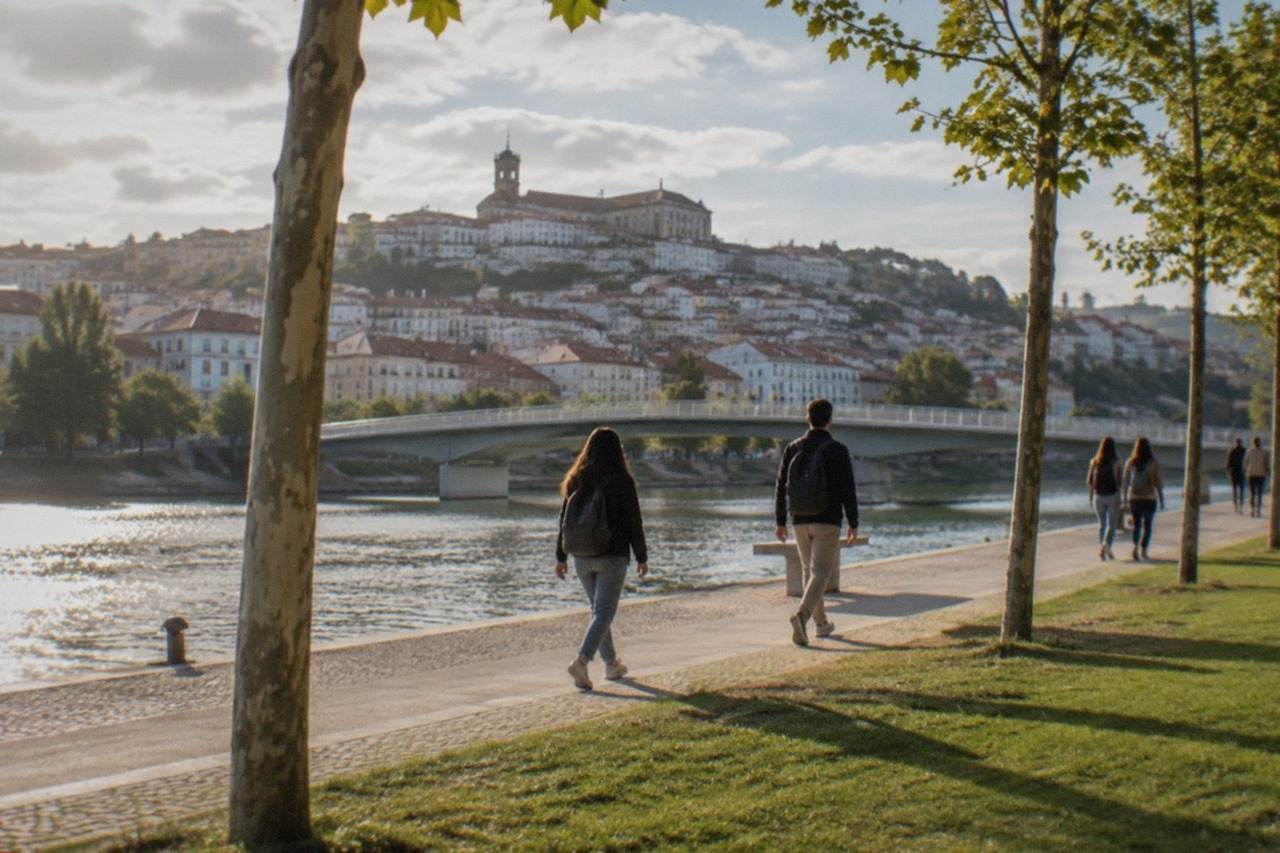
Coimbra, Portugal, the university city on the River Mondego, is the kind of place that shows up in American moving-to-Portugal conversations mostly as the cheaper, calmer alternative to Lisbon and Porto. The question of how many Americans actually live there, though, has no honest numerical answer right now, and the reason is worth understanding before you trust any figure you find online. The short version: the national statistics institute publishes resident population by nationality, but no figure for American residents in the municipality of Coimbra could be verified from an official source for this page, and even the city's total resident population is unverified on this build. What is checkable is a different set of numbers, and they say something real about the place Americans are moving to.
How Many Americans Live in Coimbra, Portugal?
No verified official count of American residents in Coimbra, Portugal exists in the sources this site could check, and any specific number read online should be treated as an estimate rather than a fact. The resident population of Coimbra itself is unverified here, and a nationality breakdown for the municipality was not available from any official page. What can be said with confidence is that Coimbra is a small university city of about 31,000 students, and that American residents form a small fraction of it.
That is an unsatisfying answer, and it is deliberately unsatisfying. Portugal's statistics institute, the INE, is the body that would publish a nationality breakdown for the municipality of Coimbra, and on this build every indicator request was rejected while the institute's own site timed out. A figure that circulates on a blog or a forum is not a substitute. The honest position is that the number exists somewhere in the national record but has not been verified from a primary source, and a page that prints a confident figure without one is guessing.
There is also a geography trap that catches most published numbers about this city. Coimbra is three different things: a city, a municipality, and a district. The district reaches the Atlantic and contains Figueira da Foz; the city does not touch the sea and has no beach. A population or residency figure quoted for "Coimbra" without saying which of the three it refers to is close to meaningless, because the district figure is roughly three times larger than the municipality's. Any count of American residents inherits exactly the same problem. If a later source supplies one, it must say municipality, or concelho, of Coimbra, or it is describing a different place.
| Claim often seen online | What the official record actually supports |
|---|---|
| A specific count of American residents in Coimbra | Not verified from any official source on this build |
| A resident population for the city or municipality | Not verified; INE data could not be read, so no figure is published here |
| Coimbra described as a UNESCO World Heritage city | False. The inscription covers the University of Coimbra, Alta and Sofia, inscribed 2013, list reference 1387, not the whole city |
| The student population | Verified: the University publishes about 31,000 students, 31,256, on its own homepage |
| Tourism volume | Verified: the municipality reports 698,151 overnight stays in Coimbra in 2025 |
The pattern in that table repeats across almost every "how many X live in Y" question about small Portuguese cities. The verified numbers describe institutions and flows: students, overnight stays, tax receipts. The unverified numbers describe people by nationality, which is the number moving-to-Portugal readers actually want. Refusing to print the second kind is not evasiveness; it is the difference between a guide and a guess.
Why no One Can Give You a Verified American Count for Coimbra
The honest reason is that the official dataset that would answer the question could not be read from a primary source, and every number in circulation traces back to estimates, forums, or secondhand summaries rather than to the statistics institute itself. Portugal does count foreign residents by nationality and municipality, but the verified figures this site could read were national or institutional ones, and a Coimbra-specific American count was not among them. Until a primary source publishes it, any number is a fabrication risk.
This matters more than it sounds, because the moving-to-Portugal content ecosystem is unusually full of invented precision. A writer who needs a number can find one in seconds, and it will look authoritative, and it will carry a decimal point, and it will be wrong in ways nobody can check. The same pressure produced the two most common factual errors about this city: the claim that Coimbra is a UNESCO World Heritage city, which is false, and a two-euro tourist tax, which is a proposal rather than the published rate. If a source gets those wrong, its American-resident count is not worth much either.
What a reader considering Coimbra can do instead is look at the shape of the place, which the verified numbers describe well. The University of Coimbra publishes about 31,000 students on its own homepage, alongside 434 courses, 1,935 professors, 378 researchers, four campuses, 22 libraries, two museums, one botanic garden and 13 residences. That student body is the engine of the city's economy and its rental market, and it is the context any American resident, whether a student, a remote worker, or a retiree, moves into. The municipality's own tourism study, published on 21 July 2026, reports 698,151 overnight stays in 2025, municipal spending directly related to tourism of 1.94 million EUR, and an estimated annual municipal cost of tourism of 2.44 million EUR. These are the numbers that describe what living in Coimbra is actually like: a small, dense, student-driven city that receives a large annual flow of visitors relative to its size.
For Americans scouting the city rather than moving yet, the practical introduction is the university hill itself, and the guided options cover it well. A reader planning a first visit may also want the broader picture in what is special about Coimbra, Portugal or the practical rundown in is Coimbra in Portugal worth visiting.
What the Official Numbers do Say About Coimbra, Portugal
The municipality of Coimbra recorded 698,151 overnight stays in 2025, spent 1.94 million EUR directly on tourism, and estimated its annual tourism cost at 2.44 million EUR, which works out to 3.49 EUR per overnight stay, figures the municipality published on 21 July 2026. The current published tourist tax remains 1.00 EUR per guest per night, capped at three consecutive nights, from age 16, in force since 5 April 2023.
That cost-per-stay figure is the genuinely interesting one, and almost no competing guide has it. It means the city's own accounting says each visitor night costs the municipality 3.49 EUR in services, while the tax it collects is one euro, and even the proposed two-euro rate would sit below cost. For a prospective American resident, this is the fiscal background to daily life: a city that is popular enough to need the tax and small enough that the numbers are measured in millions, not hundreds of millions. The wider set of guides lives on Coimbra Travel Guide.
| Official figure | Value | Source level |
|---|---|---|
| Overnight stays in Coimbra, 2025 | 698,151 | Municipality |
| Municipal spending directly related to tourism, 2025 | 1.94 million EUR | Municipality |
| Estimated annual municipal cost of tourism | 2.44 million EUR | Municipality |
| Cost per overnight stay | 3.49 EUR | Municipality |
| Tourist tax, current published rate | 1.00 EUR per guest per night, max 3 nights, age 16 and up | Municipality, in force since 5 April 2023 |
| University of Coimbra students | About 31,000, published as 31,256 | University |
The tourist tax detail is worth knowing precisely because so many pages get it wrong. The rate is one euro per guest per overnight stay, paid to the accommodation at check-in or check-out, charged all year with no low-season exclusion, and capped at three consecutive nights per person. The municipality's own worked example: a couple staying seven nights pays 3.00 EUR each, 6.00 EUR total. In July 2026 the municipal executive approved a proposal to double the tax to two euros, describing the current rate as one euro, so until the municipality's own tax pages say two, one is the number to budget. A reader weighing a longer stay can compare that against the living-cost picture in how much does it cost to live in Coimbra, Portugal.
The university is where most of this civic arithmetic originates. The inscribed UNESCO property, the University of Coimbra, Alta and Sofia, covers the university hill and the college street below it, inscribed in 2013 under criteria (ii), (iv) and (vi), and it is managed by an association founded by the University, the City Hall, the regional culture delegation and Coimbra Viva. It is not the whole city, and it is not the riverside. That distinction is the single most common error in guides to Coimbra, and it matters here because the American presence in the city, when it is visible at all, clusters around exactly these two components: the hill's academic institutions and the streets below them.
Where Americans Fit Into Coimbra's Student and Visitor Mix
Americans in Coimbra appear in the verified record as part of two flows rather than as a counted population: the University's roughly 31,000 students, a figure the institution publishes on its own homepage without stating an academic year, and the 698,151 overnight stays the municipality recorded in 2025. No official breakdown by nationality was verifiable for either group, so the honest statement is that Americans are present in both and uncounted in both.
The University's homepage publishes its numbers as a block: 31,256 students, 434 courses, 1,935 professors, 378 researchers, 1,537 technical staff, four campuses, 22 libraries, two museums, one botanic garden and 13 residences. It does not publish an international-student count on the page this build read, and a foreign-nationality figure that circulates elsewhere is unverified. What is fair to say is that a university of that size, in a city of this scale, is the dominant social reality. Anyone moving to Coimbra from the United States is moving into a student city first and everything else second.
For American students and visiting families, the practical pinch point is the Biblioteca Joanina, and it illustrates how the city's small size translates into scarcity. The library admits 50 people every 20 minutes, a ceiling the University states verbatim, and it cannot be bought on its own: it exists only inside the 16.50 EUR combined ticket, and the time printed on that ticket is the library slot specifically. Entry outside the slot is refused, and online purchase closes 20 minutes before the visit time. The University also closes its whole visitor circuit on 24 May, and Mosteiro de Santa Cruz suspends visits on the Cortejo da Queima das Fitas, a moveable Sunday, so late May is a fragile time to plan around. A reader working out a first itinerary should read what not to miss in Coimbra alongside the ticket rules.
The two stations question also lands on Americans arriving by train, and it is a genuine trap: Coimbra-B and Coimbra-A are different stations in different places, and the specifics of which trains call where, and whether the shuttle between them is free with a long-distance ticket, are unverified on this build, so CP's own site is where to check. The summary in what is the difference between Coimbra and CoimbraB train stations covers what can be said without guessing.
Is Coimbra a Realistic Base for Americans Moving to Portugal?
Coimbra is a realistic base for Americans who want a small, walkable, university-driven Portuguese city with lower visitor pressure than Lisbon or Porto, and the verified numbers support that framing: about 31,000 students, 698,151 overnight stays in 2025, and a municipal tourism cost of 3.49 EUR per stay against a one-euro tax. What the numbers cannot yet support is a claim about how many Americans have already made that choice, because no official count has been verified.
The city's climate, from IPMA's 1991 to 2020 normals for the Coimbra / Bencanta station, the city's own station 3 km from the centre, is another part of the case. August is the hottest month rather than July, with a mean maximum of 29.1 C and 10.9 days above 30 C, and the autumn rain holds off until October, when the monthly total jumps from 49.9 mm to 114.5 mm. September is the quiet surprise: a mean maximum of 27.4 C, higher than June's 26.3 C, with the crowds gone. November is the wettest month at 121.5 mm. For an American comparing Coimbra against the Algarve or Lisbon, that is a four-season climate with a dry, warm summer and a genuinely wet winter, and it is measured at the city's own station rather than a coastal proxy, which matters because the district reaches the Atlantic and the city does not.
| Month | Mean maximum (C) | Rain (mm) | What it means for a newcomer |
|---|---|---|---|
| June | 26.3 | 26.0 | Warm and dry, student year ending |
| July | 28.5 | 8.9 | Effectively dry, peak heat building |
| August | 29.1 | 14.8 | Hottest month, 10.9 days above 30 C |
| September | 27.4 | 49.9 | Warmer than June, crowds thinning |
| October | 23.2 | 114.5 | The autumn rain arrives in earnest |
| November | 18.0 | 121.5 | The wettest month of the year |
The honest closing position on the original question is a negative result with a positive use. No verified count of American residents in Coimbra exists in the sources this site could check, and this page declines to print one, but the verified figures that do exist, the students, the overnight stays, the tax arithmetic, the climate record, describe the city an American would actually be moving to with more accuracy than an invented headcount ever could. Readers weighing the move can start with is it worth going to Coimbra, Portugal and the practicalities in where is the best place to stay in Coimbra, and treat any confident American-population figure they meet elsewhere with the skepticism it has earned.

Common Questions About Americans Living in Coimbra
How many Americans live in Coimbra, Portugal?
No verified official count exists. The statistics institute's data could not be read from a primary source on this build, and even the municipality's total resident population is unverified here, so this site publishes no number rather than a guess.
Does Coimbra have a large American community?
There is no official figure, but the verified context suggests a small community within a small city. The University publishes about 31,000 students and the municipality recorded 698,151 overnight stays in 2025, and Americans appear in both flows without being counted in either.
Is Coimbra cheaper than Lisbon or Porto for Americans moving to Portugal?
This site does not publish comparative cost figures for other cities, because none were verified. What is verified for Coimbra itself is the tourist tax, 1.00 EUR per guest per night capped at three nights, and the living-cost detail in the site's dedicated cost-of-living answer page.
Do I need to pay the Coimbra tourist tax if I move there?
The tax applies to overnight stays in tourist developments and local accommodation, paid to the accommodation, not to residents in their own homes. It is capped at three consecutive nights per person, applies from age 16, and has been in force since 5 April 2023.
Is Coimbra a good place for American students?
The University of Coimbra publishes about 31,000 students, 434 courses and 1,935 professors, and its hilltop core is the UNESCO-inscribed University of Coimbra, Alta and Sofia, listed in 2013. Note the Biblioteca Joanina's limit of 50 people every 20 minutes if you are planning visits for visiting family.