Is the Train from Lisbon to Coimbra Scenic? What the Route Really Looks Like
Is the train from Lisbon to Coimbra scenic? An honest, sourced answer to the route between Lisbon and Coimbra, Portugal, plus station facts, seating advice and the best months to ride.
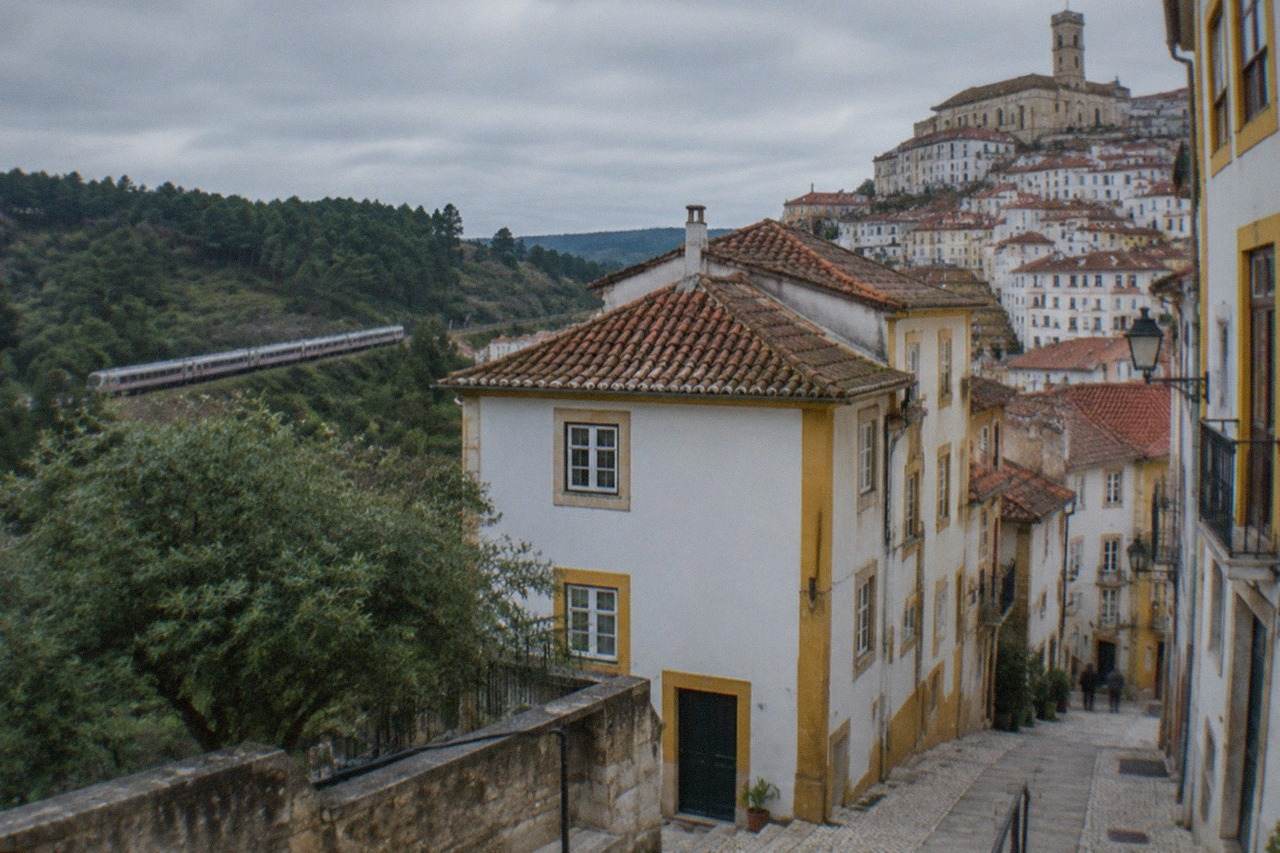
Coimbra, Portugal, the university city on the River Mondego, sits on the main rail line that connects Lisbon with the north of the country, and that geography is exactly why the question of scenery comes up so often. Riders expect either postcard coastline or continuous farmland, and the route delivers something between the two: long stretches of quiet interior landscape, eucalyptus and pine, farmed valleys, and a final approach into a city built on a hill above a river. This page answers the question directly, then covers the practical details that shape the experience, from which station you arrive at to which months give the best light and the fewest crowds.
What Does the Lisbon to Coimbra Rail Route Actually Pass Through?
The route runs north from Lisbon through the Ribatejo and into the Centro region, passing a landscape of flat farmland, river valleys, pine and eucalyptus plantations and low forested hills before the train reaches Coimbra. It is a pleasant, quietly rural ride rather than a dramatic one, with no single headline view and no coastline, because the line runs through the interior and the Atlantic is well to the west of the tracks.
That is the honest framing. The first stretch out of Lisbon is flat and agricultural, the wide Tagus floodplain giving way to the fields and olive groves of the interior. As the train pushes into the Centro region the terrain begins to roll, and the window fills with the planted forest that covers so much of central Portugal: eucalyptus in dense stands, maritime pine, and the occasional bare granite outcrop. Small stations pass through villages that exist because of the line itself.
What the route does not offer is equally worth knowing. It does not hug the coast, so there is no ocean scenery at any point. It does not climb into high mountains. And it does not run alongside the Mondego until you are effectively in Coimbra, where the river and the stacked city, with the university hill and its tower above the rooftops, make the arrival the most memorable few minutes of the journey. For more on the city at the end of the line, the guide to Coimbra's main attractions covers what deserves your time once you step off the train.
Is the Train from Lisbon to Coimbra Scenic?
Scenic is a generous word for it, and pleasant is the accurate one. The ride from Lisbon to Coimbra, Portugal is a calm, green, rural journey with rolling forested hills in its middle section and an attractive arrival into a river city built on a hillside, but it is not a headline scenic railway in the way a coastal or mountain route would be. Travellers who expect continuous views will be disappointed, and travellers who enjoy watching quiet countryside will enjoy it.
The verdict depends almost entirely on expectations. If the comparison is a mountain line or a coastal route, this is ordinary main-line running through working landscape: farmland, plantation forestry, small towns. If the comparison is the motorway, which runs through some of the same country at speed and behind barriers, the train wins comfortably, because the line is older than the road and passes closer to the villages, the fields and the texture of the region.
The strongest argument for the ride is what it delivers at the end. Coimbra's eastern approach gives you the city from below and from the side, the hill stacked with buildings, the university quarter above, and the Mondego running through the middle of it all. After an hour or more of green nothing-in-particular, that arrival lands with real impact. The University of Coimbra's own published figures describe an institution of about 31,000 students, and the city they live in is the payoff of the journey.
There is also a planning angle worth naming. If scenery is the point of the day rather than a bonus, a guided day trip changes the equation entirely, because it can reach places the railway cannot. The Coimbra Top Attractions Walking Tour covers the city's hill, monasteries and viewpoints on foot in two and a half hours, from $5.85 per person, rated 5 from 151 reviews on the operator's live listing.
Which Side of the Train Gives the Better Views?
There is no single "correct" side, because the scenery is distributed across both, but a seat on the western side of the train gives slightly more variety on the middle section, while the arrival into Coimbra rewards whichever side faces the city hill, and the honest advice is not to overthink it: the differences are marginal, the landscape is rolling rather than one-sided, and any window seat delivers the worthwhile parts of the ride.
The route bends and switches direction enough that a fixed rule would be false precision, and this site does not publish unsourced operational detail about the line. What can be said with confidence is practical: take a window seat, keep the ticket handy, and treat the final approach as the part worth watching for. The city appears as a hillside of tiled roofs and white walls with the university quarter above, and the river crossing puts the whole composition in one frame.
For travellers who want the arrival to be the highlight rather than a surprise, the planning guide for the Lisbon to Coimbra journey collects the practical decisions in one place, and the answer on whether there is a train from Lisbon to Coimbra covers the basics of the connection.
What Should You Know About Coimbra's Two Stations?
Coimbra has two railway stations with confusingly similar names, Coimbra and Coimbra-B, and they are in different places, which matters for how you finish your journey. This site does not publish which trains call at which station, the distance between them, or whether a connecting shuttle is included with a long-distance ticket, because those specifics could not be verified from the operator, CP, Comboios de Portugal, whose own passenger site is the place to check the stopping pattern and any connection.
The two-stations situation is the single most common practical trap on this route, and the honest position is that the details change with timetables and ticket types. What does not change is the geography: one station sits closer to the city centre and the historic hill, the other serves as the stop for through services, and the difference between them can add real time and effort to your arrival if you plan badly. The full explanation of the difference between Coimbra and Coimbra-B covers what is verified, and the guide to the two stations puts it in the context of arriving in the city.
Once you are off the train, the city rewards the effort. The University of Coimbra's own visit pages state that the Biblioteca Joanina admits 50 people every 20 minutes and that the library cannot be bought as a standalone ticket, existing only inside the 16.50 EUR combined ticket, so a late arrival can genuinely cost you the one interior most visitors come for. That is a planning constraint, not a scare story, and it is the strongest argument for not treating the arrival as loose.
When Is the Best Month to Make the Ride?
The best months for the Lisbon to Coimbra train ride are May, June, September and early October, because IPMA's 1991 to 2020 normals for the Coimbra / Bencanta station show warm, comparatively dry weather then, with September in particular offering a mean maximum of 27.4 C, higher than June's 26.3 C, while the crowds of summer have gone and the heavy autumn rain has not yet arrived, since the monthly total jumps from 49.9 mm in September to 114.5 mm in October.
The climate table deserves reading before any booking, because it corrects a common assumption. September is both hotter and wetter than June, 27.4 C against 26.3 C and 49.9 mm against 26.0 mm, so it is not a drier copy of early summer, it is a different proposition: warmer days, nearly twice the rain, and far fewer competitors for library slots and restaurant tables. What makes it the quiet recommendation is that the real autumn rain holds off until October.
| Month | Mean max C | Rain mm | Days with 1 mm+ rain | Days above 30 C |
|---|---|---|---|---|
| May | 23.3 | 64.7 | 8.5 | 3.5 |
| Jun | 26.3 | 26.0 | 3.7 | 6.2 |
| Jul | 28.5 | 8.9 | 1.7 | 8.9 |
| Aug | 29.1 | 14.8 | 2.2 | 10.9 |
| Sep | 27.4 | 49.9 | 5.2 | 7.8 |
| Oct | 23.2 | 114.5 | 10.3 | 2.0 |
Two more facts from the same official table are worth carrying. August, not July, is the hottest month in Coimbra on both mean and mean maximum, averaging 10.9 days above 30 C, so midsummer riders should expect a warm arrival and a climb to the university hill. And November is the wettest month at 121.5 mm, marginally ahead of October and January, which makes late autumn the season to trade views from the train window for interiors.

What Practical Facts Should You Have Before Arriving?
Coimbra charges a municipal tourist tax of 1.00 EUR per guest per overnight stay, capped at three consecutive nights, from age 16, paid directly to the accommodation at check-in or check-out, and the municipality's own 2025 figures record 698,151 overnight stays in the concelho, with an estimated municipal cost of 3.49 EUR per overnight stay, which is why a rise to two euros has been proposed but is not yet the published rate.
That tax detail catches out visitors who budget to the euro, because it is charged all year with no low-season exclusion, and it is not collected through a booking platform. The overnight-stay figure is the municipality's own, for the municipality, not the district, and it is the kind of sourced context almost no competing guide carries.
The arrival-day facts that matter most are the ones with hard limits attached:
| Practical item | Verified detail |
|---|---|
| Tourist tax | 1.00 EUR per guest per night, max 3 nights, from age 16, paid to the accommodation |
| Biblioteca Joanina | 50 people every 20 minutes, timed slot printed on the ticket, no standalone sale |
| University combined ticket | 16.50 EUR adult, valid two days except the fixed Joanina slot |
| University opening hours | 09:00 to 20:00 summer, 09:00 to 17:30 winter, per the University's visit pages |
| University circuit closures | 24 May and 4 October in the current published cycle |
The 24 May closure is worth a special note. It falls around the Queima das Fitas student festival, held in May, and Mosteiro de Santa Cruz also suspends visits on the Cortejo, a moveable Sunday, so a spring arrival can coincide with the city at its most alive and its monuments at their least accessible. Check the University's own visit pages before locking a date, and see the guide to Queima das Fitas for what is and is not verified about the festival itself.
If a self-guided arrival feels like too much logistics for one day, a guided alternative exists. The full-day trip from Porto covering Coimbra and Aveiro with a boat ride runs from $114 per person, rated 4.7 from 106 reviews on the operator's live listing, and it suits travellers who want the region's two most contrasting cities handled end to end.
For anyone weighing the train against other ways of reaching the city, the comparison is not really about scenery at all. A guided day trip trades the window seat for a guide's commentary and a route that can stop, and for many travellers that trade is worth making at least once. Whichever way you arrive, the practical constraints above, the timed library slots, the two stations and the tax, are identical, so the planning work is shared.
Common Questions About the Lisbon to Coimbra Train
Is the train from Lisbon to Coimbra scenic?
Pleasant rather than dramatic. The route runs through the interior of central Portugal, passing farmland, planted forest and low hills, with no coastline, and it finishes with an attractive arrival into a hillside river city. It is not a headline scenic railway, but it beats the motorway for interest.
Is there a train from Lisbon to Coimbra?
Yes, Coimbra is on the main north-south rail line through Portugal and is a regular destination from Lisbon. The specifics of services, fares and times should be checked with the operator, CP, Comboios de Portugal, whose passenger site publishes the current timetable.
Which station should I arrive at, Coimbra or Coimbra-B?
Coimbra has two stations with confusingly similar names, in different places. This site does not publish which trains call at which, the distance between them, or whether a connecting shuttle is included with a long-distance ticket, because those details could not be verified from CP. Check the stopping pattern on the operator's own site before booking.
How many days do I need in Coimbra after the train ride?
One full day covers the university hill, the Biblioteca Joanina and the old town at a reasonable pace, and two days allow the monasteries, the riverside and a slower rhythm. The timed Joanina slots, 50 people every 20 minutes, are the constraint that shapes any short stay.
Can I visit Coimbra as a day trip from Lisbon?
Yes, travellers do it, though the day is shaped by the two-station arrival and the timed library slots. A realistic plan starts with the University's own visit pages for slot availability and with CP for the stopping pattern.
What is the best month for the ride?
May, June, September and early October, per the official climate normals for the Coimbra / Bencanta station. September is the quiet recommendation: a mean maximum of 27.4 C, higher than June, with the heavy autumn rain holding off until October, when the monthly total jumps to 114.5 mm.
The rail route between Lisbon and Coimbra will never be marketed as a scenic railway, and that is fine, because its job is to deliver you efficiently into one of Portugal's most photogenic small cities, and the arrival, hill, river and rooftops together, does that work beautifully. Plan the seat, check the stations with CP, book the Joanina slot early, and the ride becomes a calm green prelude to the best view of the whole journey, one that Coimbra Travel Guide covers in depth across every page of this site.